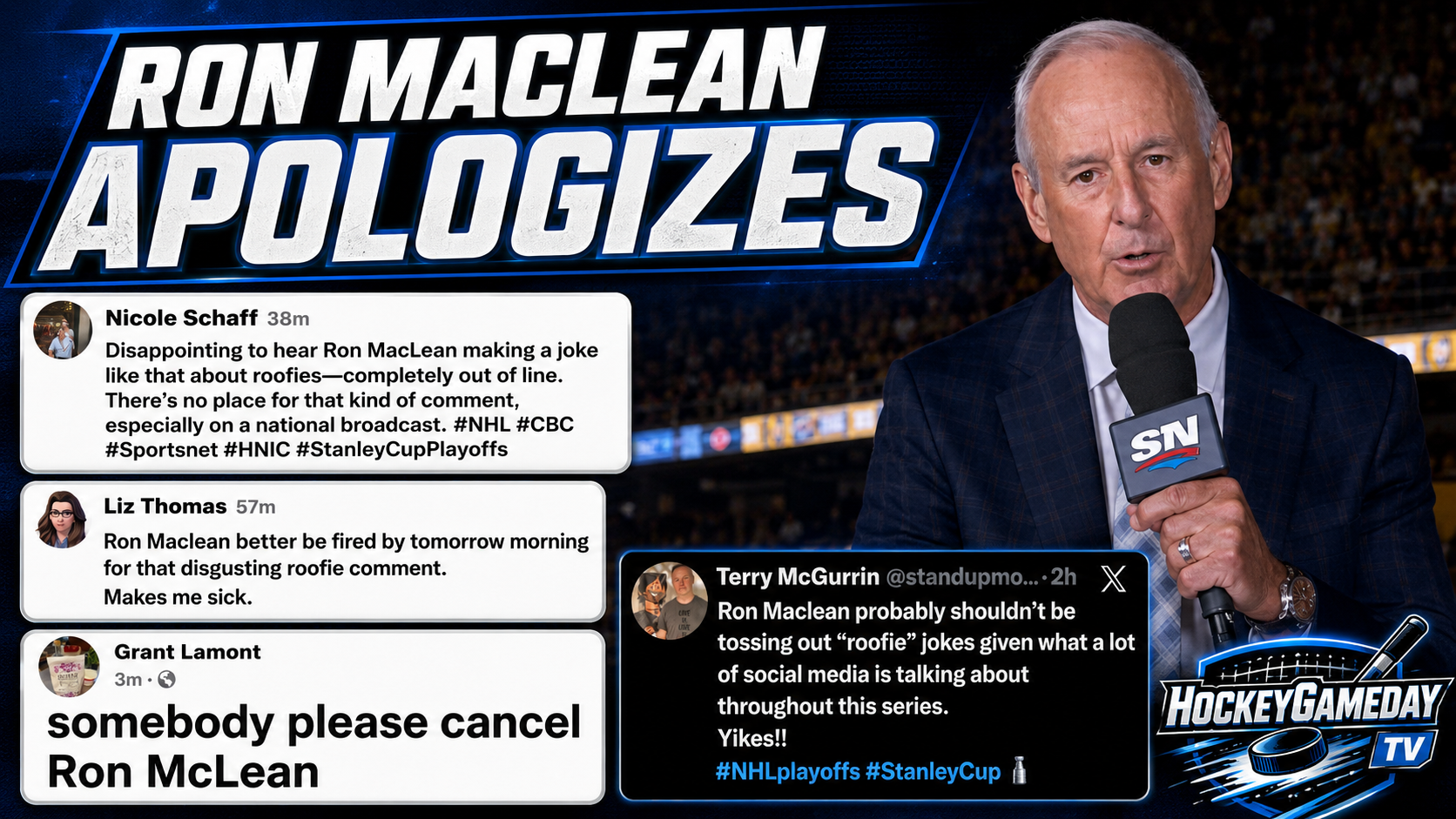
Ron MacLean has been around hockey television long enough to know that live TV can turn on a dime. One second, a panel is trying to fill time, loosen the mood, and make a light joke during a massive Stanley Cup Final broadcast. The next second, a comment lands wrong, viewers react, and suddenly the conversation is no longer about the game.
That appears to be what happened during Sportsnet’s coverage of Game 6 of the Stanley Cup Final, when MacLean made a public apology after what viewers described as a “roofies” comment during the broadcast.
Based on live viewer reaction, the moment involved a lighthearted cutaway or discussion around the Stanley Cup, the Cup’s longtime keeper Phil Pritchard, and what sounded like a joking “party” or “hangover” type setup. During that exchange, MacLean reportedly made a remark along the lines of “the roofies, they get you every time,” which quickly raised eyebrows online.
And honestly, it is not hard to understand why.
“Roofies” is a slang term most commonly associated with drugs used to spike drinks, incapacitate people, and commit sexual assault. So even if the line was intended as a throwaway joke in a goofy, late-game hockey broadcast moment, the word itself carries a much darker meaning than a simple hangover joke. There are certain words that immediately change the tone of a room, and that is one of them.
That is why MacLean apologized publicly on the broadcast. It was the kind of comment where intent and impact can be two very different things. Maybe he was trying to make a bad joke. Maybe he was trying to riff off the idea of someone being passed out after a celebration. Maybe, in the moment, he did not process how the wording would sound to people watching at home. But once it was said, it was out there. And on a national broadcast during one of the biggest hockey nights of the year, it was always going to get noticed.
MacLean is not some random rookie broadcaster who stumbled into a hot mic. He is one of the most recognizable hockey voices in Canada, a longtime Hockey Night in Canada host, and someone who has spent decades navigating emotional, awkward, funny, serious, and controversial moments on live television. Sportsnet announced back in 2016 that MacLean would return as host of Hockey Night in Canada, after already being one of the signature faces of the program for decades.
That history is part of why the apology mattered. Viewers know MacLean. Many grew up watching him. He has built a reputation as a thoughtful, polished broadcaster who often tries to bring a poetic or human angle to hockey coverage. But that same reputation also means people expect him to understand when something crosses a line.
This is not the first time MacLean has had to apologize for an on-air comment. In 2021, he apologized after a remark during a Maple Leafs-Canadiens playoff broadcast caused backlash. That comment involved Kevin Bieksa, a shirtless photo, and the phrase “you’re definitely positive for something,” which some viewers interpreted as offensive. MacLean later said he was “deeply sorry” and explained that he regretted what happened during the segment.
There was also the much bigger 2019 Don Cherry controversy, where MacLean apologized for not immediately challenging Cherry’s comments about immigrants and poppies on Coach’s Corner. Sportsnet later parted ways with Cherry, ending one of the most famous and divisive partnerships in Canadian hockey television history.
That is why this latest situation instantly became a talking point. For some fans, it will be another example of MacLean putting his foot in his mouth during a national broadcast. For others, it will be seen as a bad joke that was corrected quickly with an apology. Both things can be true at the same time.
Live television is unforgiving. Hockey panels are not scripted like a movie. Broadcasters are reacting in real time, trying to be informative, funny, entertaining, and sometimes emotional all at once. That does not excuse every comment, but it does explain how messy moments happen. A joke that might have been meant as harmless can sound completely different once millions of people hear it.
The larger issue is that jokes about drugging someone are not just “edgy.” They hit a real nerve because they are connected to real harm. There are people watching who have personal experiences with drink-spiking, sexual assault, or situations where they were made vulnerable without consent. To those people, hearing a “roofies” joke casually dropped into a hockey broadcast is not just awkward — it can feel gross, dismissive, and completely unnecessary.
That is the part broadcasters have to understand now. Sports coverage is still allowed to be funny. It should be funny. The best panels have personality. Kevin Bieksa’s dry humour, Elliotte Friedman’s awkward charm, Jennifer Botterill’s sharp analysis, Kelly Hrudey’s calm presence, and MacLean’s storytelling are all part of what makes Sportsnet’s coverage feel familiar. But there is a difference between a harmless chirp and a joke built around something that carries a serious social meaning.
MacLean apologizing was the right move. Whether fans think the apology was enough will depend on how they viewed the original comment. Some will say it was just a dumb live-TV mistake and people need to move on. Others will say someone with MacLean’s experience should know better than to reach for that kind of joke, especially during the Stanley Cup Final.
The truth probably sits somewhere in the middle. It was not the scandal of the century, but it also was not nothing. It was a bad line, on a huge stage, from a broadcaster who knows how much words matter.
And that is what makes the moment so strange. Game 6 of the Stanley Cup Final should be remembered for the hockey: the tension, the stars, the saves, the pressure, the crowd, the possibility of a championship being won or a series being pushed further. Instead, at least for a stretch of the night, a chunk of the conversation shifted to Ron MacLean having to apologize for a joke that never needed to be made.
That is usually how these things go. Nobody tunes into a Stanley Cup broadcast expecting a controversy from the host. But when a comment hits the wrong note, especially one involving a term like “roofies,” the apology becomes part of the story.
MacLean has survived awkward broadcast moments before, and he will probably survive this one too. But it is another reminder that in 2026, especially on national television, the old “just joking around” defence only goes so far.
Some jokes are not worth the trouble.
And this was one of them.