
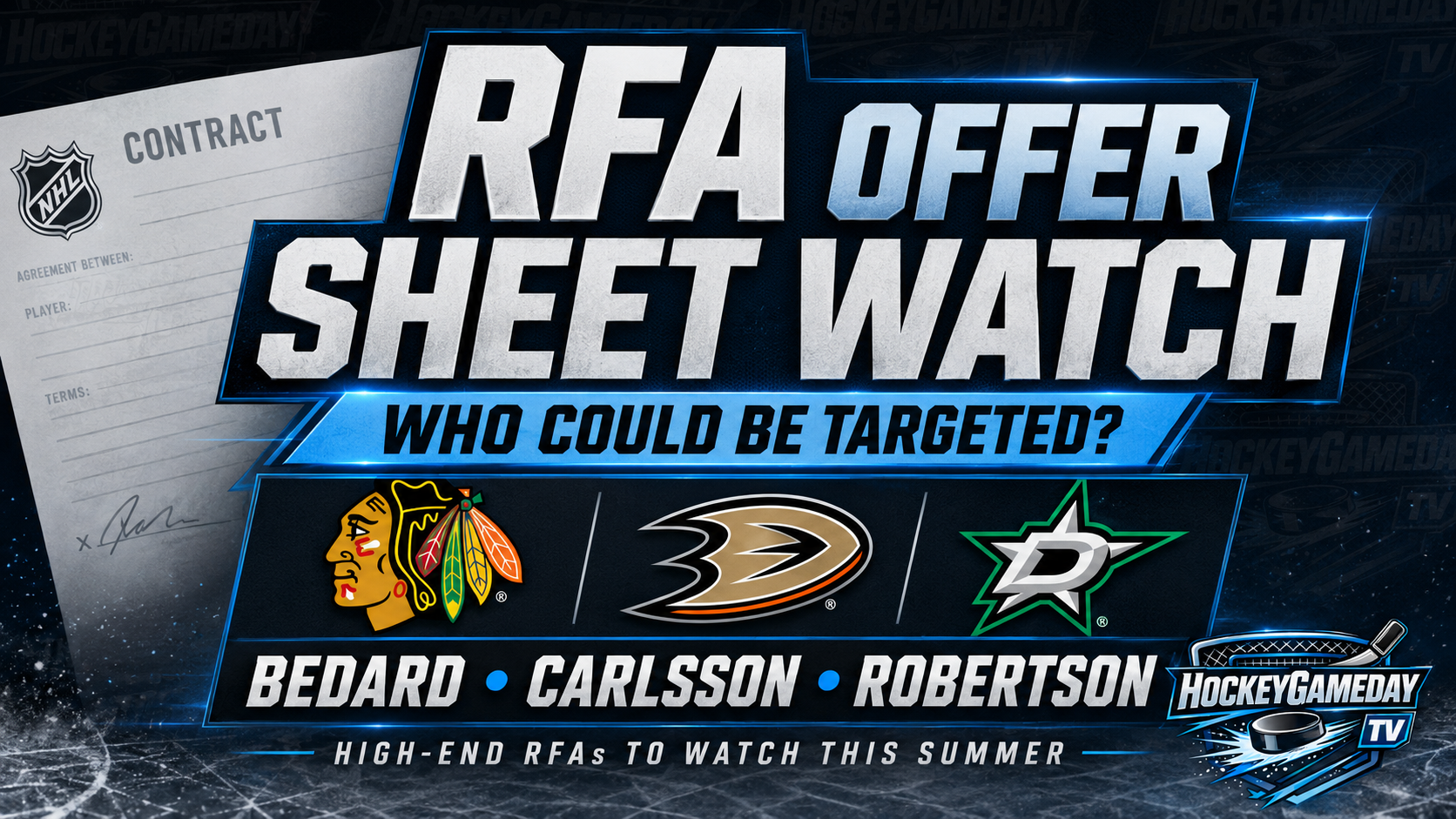
Every summer, hockey fans hear the same thing.
“This team should offer sheet him.”
And most of the time, nothing happens.
That’s what makes the NHL offer sheet so interesting. It is technically allowed. It is sitting right there in the rulebook. It can change a team’s future overnight. But for years, NHL general managers treated it like some kind of hockey sin.
Then the St. Louis Blues reminded everyone in 2024 that, yes, offer sheets are still real.
So let’s break it down in normal terms.
What Is An RFA?
An RFA is a restricted free agent.
That means the player’s contract has expired, but his current team still controls his rights, as long as they made him a qualifying offer. The player is not totally free to sign wherever he wants like a UFA.
But here is the catch.
Another NHL team can still step in and offer that player a contract. That is called an offer sheet.
The player has to sign it. The new team cannot just force it. Once the player signs, things get very uncomfortable very quickly.
What Happens After A Player Signs One?
Once an RFA signs an offer sheet, his current team gets seven days to make a decision: match the contract or let him go. If they match, the player stays and the exact contract becomes theirs. If they do not match, the player joins the new team and the original team receives draft-pick compensation.
That is the whole game.
It is not just about money. It is about pressure.
A smart offer sheet is usually designed to hit a team where it hurts. Maybe the team is tight against the salary cap. Maybe the contract has a high AAV. Maybe the term is awkward. Maybe it walks the player to free agency. Maybe it forces a rival to make a decision before they are ready.
That is why fans love the idea.
That is also why general managers hate it.
The Draft Pick Cost
The more expensive the offer sheet, the more painful the compensation becomes.
For the 2025-26 offer-sheet compensation tiers, the ranges are based on AAV and adjusted annually. PuckPedia lists the current tiers from no compensation at the lowest level all the way up to four first-round picks for the biggest deals.
For 2026, the compensation chart looks like this:

One important detail: teams generally need to use their own original draft picks as compensation, not picks they acquired from someone else. That matters because a team cannot always just collect random picks and fire off an offer sheet whenever it wants.
Why Don’t Teams Do This More Often?
Because the NHL is still an old-school league.
General managers remember who tried to take their players. Agents remember who made things messy. Owners remember who forced them into uncomfortable contracts.
There is also the simple reality that offer sheets are risky. If you make one too low, the other team just matches. If you make one too high, you might get the player but overpay badly. If you target the wrong player, you could lose major draft capital for someone who is not worth it.
But when it works, it can be brilliant.
And when it fails, it can still force another team into a contract they did not want to sign.
That is the beauty of it. Offer sheets are not always about stealing a player. Sometimes they are about creating a problem.
Recent Example: Broberg And Holloway To St. Louis
This is the one that brought offer sheets back into the spotlight.
In August 2024, the St. Louis Blues signed Philip Broberg and Dylan Holloway to offer sheets from the Edmonton Oilers. Edmonton had just gone on a deep playoff run and was dealing with a tight cap situation. St. Louis saw an opening and attacked it.
The Oilers chose not to match. Broberg and Holloway went to St. Louis, while Edmonton received a second-round pick for Broberg and a third-round pick for Holloway.
That was the rare offer-sheet win where the team actually got the players.
And it made the rest of the league look around and wonder why more teams do not try this.
Jesperi Kotkaniemi And The Hurricanes’ Revenge Shot
The most dramatic recent offer sheet before that was Jesperi Kotkaniemi.
In 2021, the Carolina Hurricanes signed Kotkaniemi away from the Montreal Canadiens on a one-year, $6.1 million offer sheet. Montreal decided not to match, and Carolina got the player. Montreal received a first-round pick and a third-round pick as compensation.
The drama around this one was impossible to ignore because two years earlier, Montreal had tried to offer sheet Carolina star Sebastian Aho. Carolina matched that Aho offer sheet, but the Kotkaniemi move felt like payback to a lot of fans. Even the tiny $20 signing bonus became part of the story because Aho wears No. 20. ESPN later reported Aho said the $20 signing bonus was “pretty funny.”
That is why offer sheets are different from trades.
They feel personal.
Sebastian Aho: Montreal Tried, Carolina Matched
In 2019, the Canadiens went after Sebastian Aho, signing him to a five-year, $42.27 million offer sheet. Carolina quickly made it clear they were going to match, keeping their franchise centre.
This is the other side of the offer-sheet game.
Montreal did not get Aho. But they still forced Carolina to sign him to that specific contract structure.
Sometimes that is the point. You might not get the player, but you might make another team uncomfortable.
Dustin Penner: One Of The Big Ones
Back in 2007, the Edmonton Oilers signed Dustin Penner to a five-year, $21.25 million offer sheet after he had helped the Anaheim Ducks win the Stanley Cup. Anaheim did not match, and Penner went to Edmonton.
That one caused real heat around the league. It was not just a transaction. It was viewed as aggressive, maybe even disrespectful by old-school hockey standards.
But that is the point. Offer sheets are supposed to be aggressive.
You are not politely asking another team for a trade. You are going around them, going straight to the player, and forcing the original team to react.
Shea Weber: The Monster Offer Sheet
One of the wildest offer sheets ever came in 2012, when the Philadelphia Flyers signed Shea Weber to a massive 14-year offer sheet worth more than $100 million. Nashville matched it and kept Weber.
That was a massive flex by Philadelphia.
It did not land them Weber, but it forced Nashville into one of the biggest contract decisions in league history. That is why offer sheets can be so dangerous. Even when the player stays, the original team might be stuck with a deal it never wanted to negotiate on those exact terms.
Ryan O’Reilly: The Almost Disaster
In 2013, the Calgary Flames signed Ryan O’Reilly to an offer sheet while he was with the Colorado Avalanche. Colorado matched it, but the situation became famous because Calgary may have run into waiver complications had Colorado not matched. Sportsnet later described the Flames as fortunate the Avalanche matched.
That one is a reminder that offer sheets are not just “throw money at player, get player.”
The details matter. Eligibility matters. Compensation matters. Cap space matters. Timing matters.
One mistake can make a bold move look reckless fast.
Why Offer Sheets Might Become More Common
The NHL salary cap is rising, young players are getting paid earlier, and teams are constantly looking for creative ways to add talent without giving up established roster players.
That is where offer sheets get interesting.
A rebuilding team with cap space can target a cap-strapped contender. A team with extra picks can make life miserable for a rival. A player who feels undervalued can use another team’s offer to force the issue.
And after St. Louis successfully landed Broberg and Holloway, the fear factor might not be as strong as it used to be.
The old unwritten rule was simple: do not mess with another team’s RFAs.
But the modern NHL is changing. Teams are more aggressive. Cap space is weaponized. Young players are not waiting forever to get paid.
The Bottom Line
An offer sheet is one of the NHL’s most fascinating tools because it creates instant chaos.
The player gets leverage.
The signing team gets a chance to steal talent.
The original team gets backed into a corner.
The fans get drama.
Most of the time, nothing happens.
But when it does?
Not Everybody pays attention.