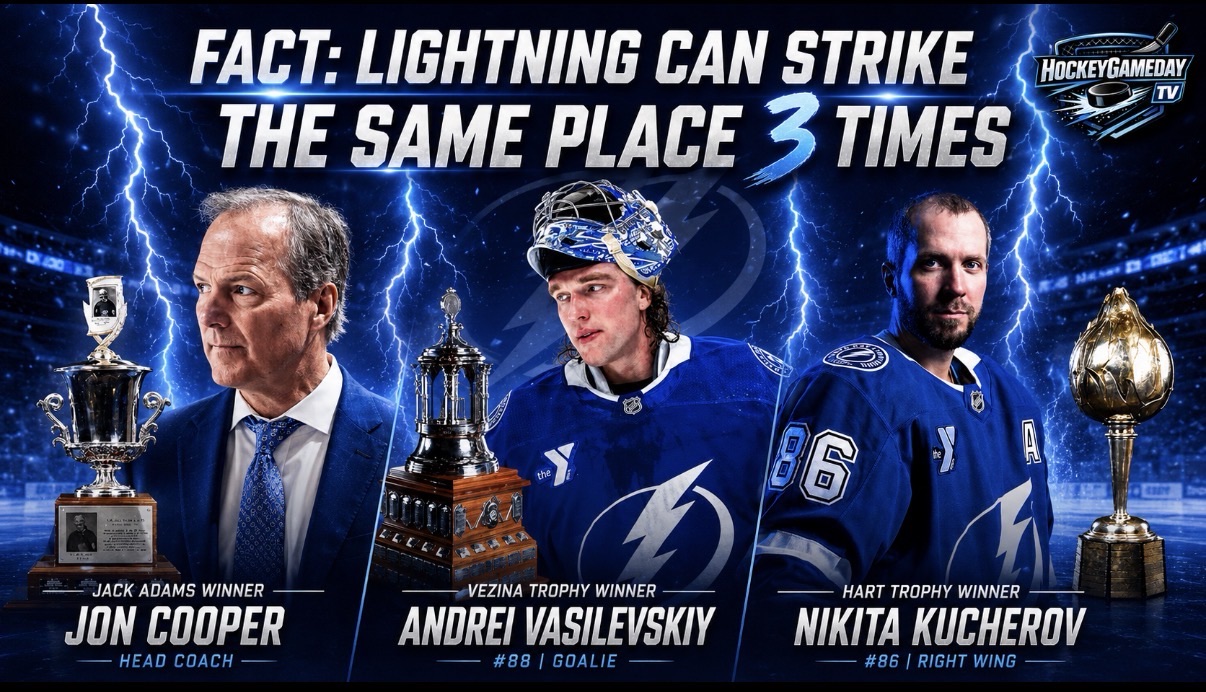
The Tampa Bay Lightning may not have been the last team standing this spring, but when award season rolled around, the hockey world was reminded of something pretty obvious: this organization is still loaded with elite talent, elite leadership, and elite standards.
Jon Cooper. Andrei Vasilevskiy. Nikita Kucherov.
Three different awards. Three different roles. Same message.
The Lightning are not done.
This year, Tampa Bay saw Cooper win the Jack Adams Award as the NHL’s top coach, Vasilevskiy win the Vezina Trophy as the league’s top goaltender, and Kucherov win the Hart Trophy as the NHL’s most valuable player. That is not just a cool graphic. That is a statement.
And honestly? Every single one of them deserved it.
Let’s start with Jon Cooper, because sometimes the hardest thing in sports is keeping greatness from getting stale.
Cooper has been behind the Lightning bench forever in modern NHL terms. He has won Stanley Cups. He has coached superstars. He has lived through the pressure of expectations, playoff heartbreak, championship parades, roster turnover, cap problems, injuries, and the natural fatigue that comes with trying to keep a winning window open for more than a decade.
And yet Tampa Bay still won 50 games.
That matters.
The Jack Adams is not always about the flashiest story. Sometimes voters fall in love with the surprise team, the big turnaround, or the new coach who changes the room. Those stories are fair. But Cooper’s case was different. His argument was built on sustained excellence. Tampa Bay went 50-26-6, reached 106 points, grabbed another playoff spot, and kept the Lightning among the NHL’s strongest teams at both ends of the ice.
That is not easy when everyone has been trying to catch you for years.
The Lightning were near the top of the league in goal differential, goals against, goals for, penalty kill, road wins, regulation wins, comeback wins, and third-period goal differential. That is coaching. That is structure. That is buy-in.
You can have stars, sure. Tampa has plenty. But stars do not automatically give you 82 games of commitment. Stars do not automatically create a penalty kill that can swing games. Stars do not automatically keep a team hungry after years of deep playoff runs.
Cooper deserves credit because the Lightning still looked like the Lightning.
Then there is Andrei Vasilevskiy, the Big Cat, who reminded everyone that when he is healthy and locked in, there are still very few goalies on the planet in his class.
Vasilevskiy winning the Vezina should not have shocked anyone, but that does not make it any less deserved. He led the NHL with 39 wins, posted a 2.31 goals-against average, a .912 save percentage, and gave Tampa Bay the kind of nightly stability that turns a good team into a dangerous one.
The numbers are impressive, but the way he got there is what stands out.
From Dec. 20 to Feb. 25, Vasilevskiy went on an 18-game point streak, going 17-0-1. That is not just good goaltending. That is season-changing goaltending. That is the type of run that lets a team bank points, build confidence, and remind the rest of the league that beating Tampa Bay still requires solving one of the best goalies of his generation.
He allowed two goals or fewer in 35 of 58 games. Think about that. In more than half of his starts, he basically gave Tampa Bay a game script they could win. For a team with Kucherov, Brayden Point, Jake Guentzel, and that much offensive punch, two goals against or fewer is a gift.
Vasilevskiy also handled the award the way you would expect. After receiving the trophy, he said, “Professionally, this is one of your ultimate goals, but it’s all about the team.”
That is exactly why players love playing in front of him. He is a superstar, but he never makes it feel like a one-man show. He gives the team confidence, and then he gives the credit right back.
Finally, Nikita Kucherov.
There are great players, there are superstar players, and then there are players who control the entire temperature of a hockey game. Kucherov is in that last group.
His Hart Trophy case was simple: he was the most valuable player to his team because Tampa Bay’s offense ran through him every single night. Kucherov finished with 130 points in 76 games, including 44 goals and 86 assists. He led the NHL in points per game at 1.71 and finished 42 points ahead of his closest teammate.
That last number is the one that should end the debate.
Tampa Bay has talent. This is not a weak roster. But Kucherov still separated himself from everyone around him by 42 points. That is outrageous. That is not just being productive. That is driving the bus.
He recorded a point in 60 of 76 games, had 40 multi-point games, and stayed dangerous in every situation. Even strength, power play, late-game moments, playmaking, scoring — he did everything.
The Hart race was incredibly close. Connor McDavid and Nathan MacKinnon both had tremendous seasons. Nobody needs to tear them down to lift Kucherov up. But the fact Kucherov won by such a narrow margin actually makes the award more interesting. This was not a coronation. This was a heavyweight fight, and Kucherov earned it.
When he accepted the award, Kucherov kept it simple: “Just really grateful for my teammates, coaches, my family. This means a lot.”
That is the funny thing about Kucherov. His game is loud, creative, ruthless, and sometimes completely unfair. But when the moment comes, he does not need a big speech. His season already said everything.
Cooper built the standard. Vasilevskiy guarded it. Kucherov powered it.
Three trophies. Three deserving winners. One organization still proving that its championship DNA has not disappeared.
So yes, the line works perfectly.
Fact: Lightning can strike the same place three times.