When the NHL introduced the salary cap after the lost 2004-05 season, it completely changed the way teams were built.

Before that, the richest teams could spend big, load up on stars, and bully the market. The 2005 Collective Bargaining Agreement changed that forever. Suddenly, every team had a hard upper limit and a spending floor. The goal was simple: create a more balanced league, control runaway spending, and make sure smaller-market teams had a real chance to compete.
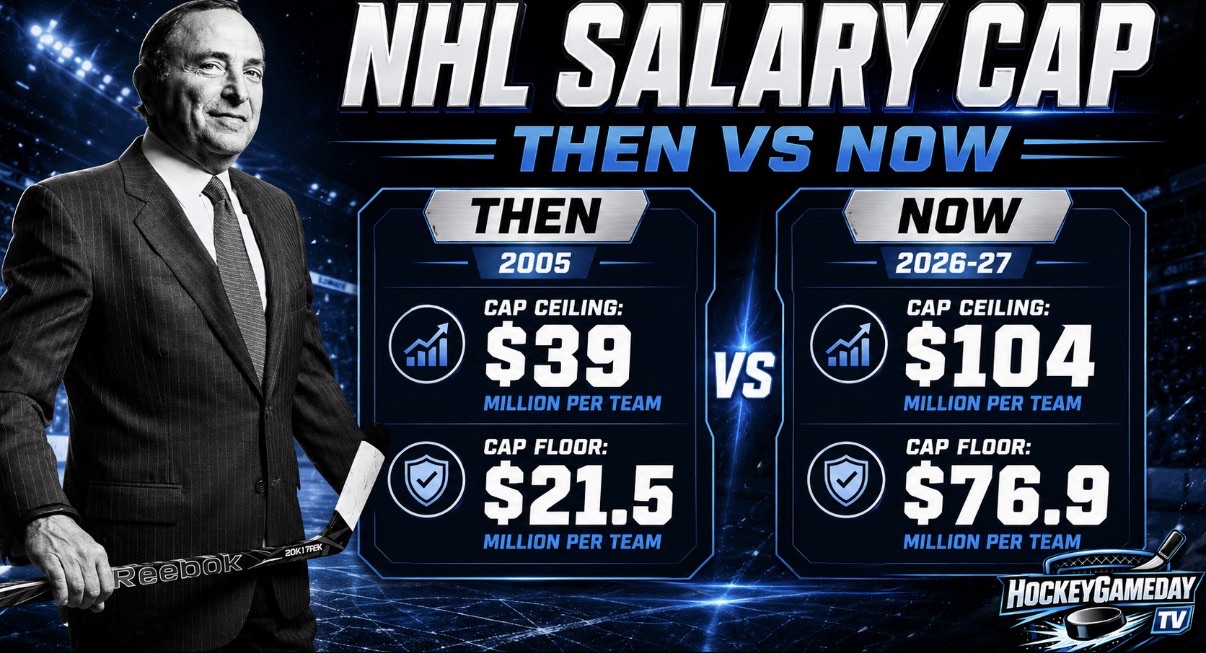
In that first salary cap season, the ceiling was $39 million per team. The floor was $21.5 million.
Fast forward to today, and those numbers almost look impossible.
For the 2026-27 NHL season, the cap ceiling is $104 million, while the floor is $76.9 million. That means the current minimum spending level is almost double what the maximum spending limit was when the cap era began.
That is wild.
The ceiling has jumped from $39 million to $104 million, an increase of roughly 167 percent. The floor has gone from $21.5 million to $76.9 million, an increase of almost 258 percent. In other words, the NHL didn’t just grow. It transformed.

So why has the cap gone up so much?
The simplest answer is revenue.
The NHL salary cap is tied to hockey-related revenue. When the league makes more money, the players’ share grows, and the salary cap rises with it. More television money, more sponsorship money, more ticket revenue, more expansion money, more playoff revenue, more merchandise, more digital content, and more global interest all push the league’s business upward.
And the NHL has become a much bigger business than it was in 2005.
When the cap era began, the league was coming out of one of its darkest moments. An entire season had been cancelled. Fans were angry. Players were frustrated. Owners wanted cost certainty. The league needed stability.
The salary cap was not just a financial tool. It was a reset button.
At first, the cap rose quickly. It went from $39 million in 2005-06 to $44 million the next year. Then it jumped to $50.3 million in 2007-08, $56.7 million in 2008-09, and kept climbing from there.
By the early 2010s, teams were already operating in a completely different world than they were in 2005. Star players were making more. Second-line players were making more. Depth players were making more. The business of hockey was clearly growing.
But the cap has not gone up in a perfectly straight line.
There have been pauses.
The 2012-13 lockout and new CBA caused a reset. Then the COVID-19 pandemic created the famous “flat cap” era, where the ceiling barely moved for several seasons. From 2020-21 through 2021-22, the cap sat at $81.5 million. It only moved to $82.5 million in 2022-23 and $83.5 million in 2023-24.
That flat cap created some of the toughest roster-building years in recent memory.
General managers had contracts on the books that were signed expecting the cap to rise. Then it didn’t. Suddenly, middle-class NHL players were squeezed. Contenders had to dump useful players. Teams became more aggressive with long-term injured reserve. Young stars came off entry-level contracts into a market where cap space was nearly impossible to find.
That is why the recent jump feels so massive.
The cap rose to $88 million in 2024-25, then $95.5 million in 2025-26, and now $104 million for 2026-27. The NHL and NHLPA have also projected the upper limit to hit $113.5 million in 2027-28.
That is a huge three-year climb.
From $88 million in 2024-25 to $113.5 million in 2027-28, the cap is projected to rise by $25.5 million. That is the kind of increase that changes the league overnight.
It changes free agency. It changes trade talks. It changes arbitration. It changes bridge deals. It changes what a superstar contract looks like.
A $10 million cap hit used to feel enormous. Now, it is becoming normal for elite players. A $12 million or $13 million player used to sound like a franchise-altering risk. Soon, it may simply be the cost of doing business if you want to keep a true superstar.
The rising cap also creates a funny situation. Teams that looked trapped a year or two ago may suddenly have breathing room. Contracts that looked ugly under an $81.5 million ceiling may look much more manageable under a $104 million or $113.5 million ceiling.
At the same time, the cap going up does not automatically make teams smarter.
Bad contracts are still bad contracts. Overpaying the wrong player is still dangerous. The only difference is that teams now have more rope. Smart organizations will use the extra money to build depth, extend their core, and stay flexible. Desperate teams may spend the new space too quickly and end up squeezed all over again.
That is the thing about the salary cap: it never really stops being a puzzle.
So what could the cap be by the 2029-30 or 2030 season?
There is no official number yet beyond the current projections through 2027-28, but we can make a reasonable estimate. If the cap reaches $113.5 million in 2027-28 and continues rising at a more moderate pace afterward, a realistic projection for the 2029-30 season could land somewhere around $125 million to $130 million.
If league revenue keeps booming, media rights continue to grow, expansion or international events add more money, and the NHL benefits from an 84-game schedule, the number could push even higher. A more aggressive projection could put the cap near $135 million by 2029-30.
That sounds crazy until you remember where this started.
In 2005, the NHL’s cap ceiling was $39 million.
Now, teams are preparing for a world where one player could eventually carry a cap hit around half of that original league-wide team ceiling.
The salary cap was created to control spending, but it has also become one of the clearest signs of how much the NHL has grown. Every increase tells a story. More revenue. More business. More star power. More pressure.
The cap era began as a way to save the league from itself.
Nearly two decades later, it has become the scoreboard for the NHL’s financial growth.
And if the next few years go the way the league hopes, today’s $104 million ceiling may look small sooner than people think.