There are spiteful hockey fans, and then there is this.
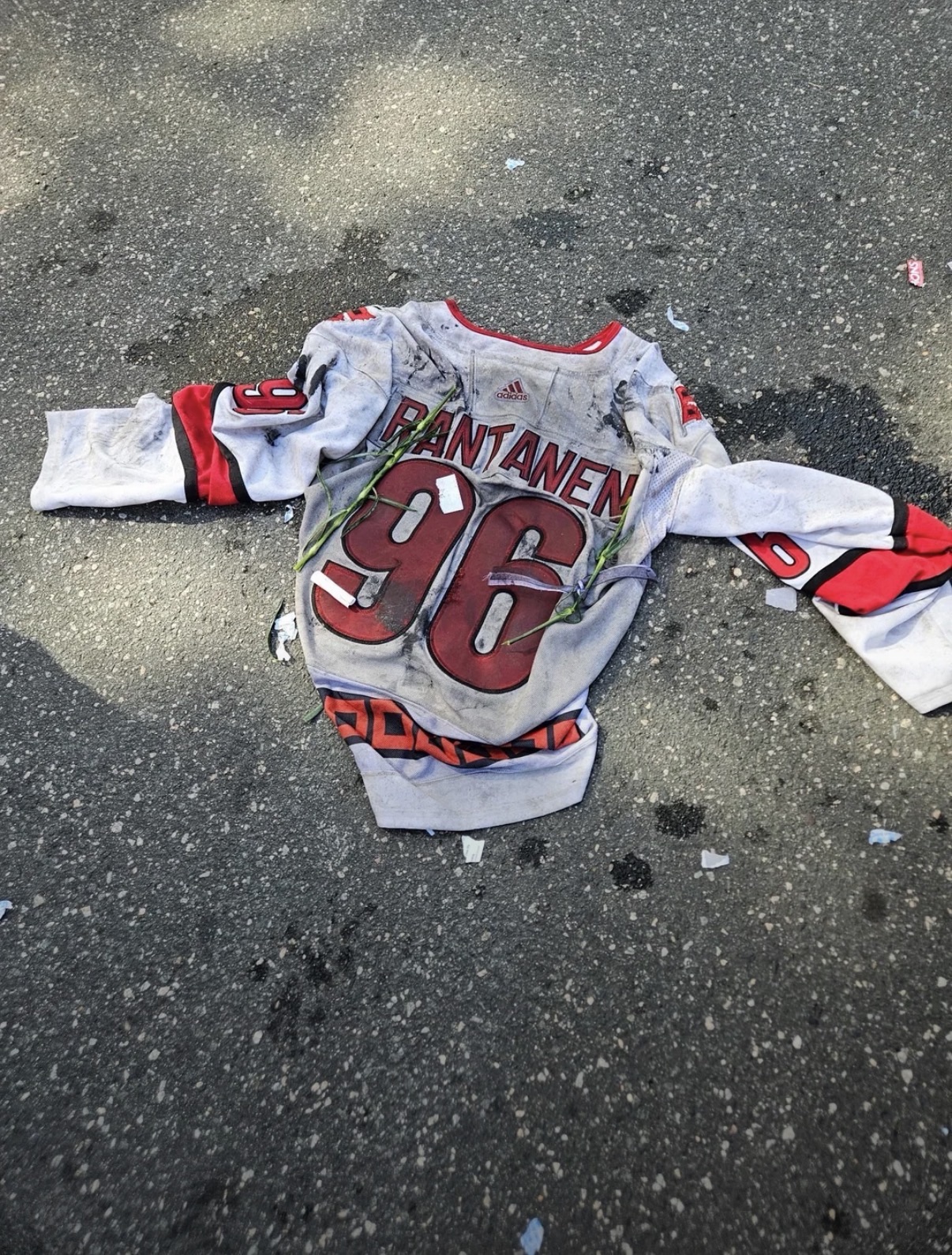
A Mikko Rantanen Carolina Hurricanes jersey lying on the pavement, covered in dirt, tire marks, and whatever else the street had to offer. Not tossed in a closet. Not sold online. Not donated. Not even burned in the usual dramatic sports-fan fashion.
Driven over.
That is what makes this image hit differently. It is not just a fan being upset. It is not just someone saying they are done with a player. It is a statement. A messy, ugly, very public statement from a fan base that clearly still has feelings about how the whole Rantanen situation went down.
But it also raises a fair question.
Is this acceptable from the Carolina faithful?
Because yes, fans had every right to be annoyed. They had every right to be disappointed. They had every right to feel like the entire thing was bizarre, frustrating, and maybe even a little embarrassing.
But at the end of the day, that jersey still has the Hurricanes crest on the front.
And in hockey, that is supposed to mean something.
The name on the back was Rantanen. The number was 96. The situation was messy. Nobody is denying that. But the crest on the front was still Carolina. It still represented the organization, the fan base, the city, and everyone else who has worn that logo with pride.
That is where this gets complicated.
Mikko Rantanen’s time with the Hurricanes was strange from the start. Carolina swung big. This was not some small deadline depth move. This was one of the best wingers in hockey, a Stanley Cup champion, a game-breaker, and a player who had been a massive part of Colorado’s success.
When the Hurricanes landed him, it felt like the kind of move contenders dream about. Carolina had been knocking on the door for years. They had the structure. They had the coaching. They had the defensive identity. They had the work ethic. What they always seemed to be accused of lacking was that true superstar finisher.
Then Rantanen arrived.
For a brief moment, it felt like the Hurricanes had finally pushed all their chips into the middle of the table.
Then came the reality.
Rantanen never truly felt like a Hurricane. Not in the way fans hoped. Not in the way the team needed. Not in the way a blockbuster addition is supposed to feel when a contender brings in a star.
And according to Rod Brind’Amour, the situation may have been doomed almost immediately.
Brind’Amour later said that when Rantanen arrived, he made it clear there were only four teams he would commit to long-term — and Carolina was not one of them.
That is a brutal thing for any fan base to hear.
Imagine being a Hurricanes fan in that moment. Your team gives up major pieces. You start talking yourself into the fit. You imagine Rantanen scoring huge playoff goals in Raleigh. You picture him beside Carolina’s core. Some fans probably bought the jersey right away, thinking they were getting in early on the start of something special.
Then you find out he never really wanted to stay.
That stings.
It does not make Rantanen evil. It does not mean he did anything wrong. Players are allowed to have preferences. They are allowed to control their future when they have earned that leverage. Rantanen had a right to decide where he wanted to sign the biggest contract of his life.
But fans are also allowed to feel burned.
That is where this jersey becomes more than just a jersey.
It represents the emotional whiplash of modern hockey. One day, a player is introduced as a potential missing piece. The next, everyone is trying to figure out why it never worked. Carolina fans barely had time to enjoy the idea of Rantanen before the entire thing turned into one of the weirdest short-term superstar chapters in recent memory.
Thirteen games.
That is all it was.
Thirteen games for the Rantanen Hurricanes era.
That barely qualifies as an era. It is more like a trivia answer. Years from now, fans will still say, “Remember when Mikko Rantanen was a Hurricane?” and it will still sound wrong.
So yes, the anger makes sense.
The photo makes sense emotionally.
But does that make it right?
That is the part worth talking about.
Because driving over a player’s jersey is one thing if you are only looking at the nameplate. But when that jersey belongs to your own team, it starts to feel different. You are not just disrespecting the player. You are dragging your own logo through the dirt too.
Hockey has always had the saying: you play for the crest on the front, not the name on the back.
That line matters here.
Rantanen may not have wanted to be in Carolina long-term. He may not have embraced the Hurricanes the way fans hoped. He may have looked at the situation and decided his future was somewhere else. That is frustrating, and nobody can blame fans for feeling some type of way about it.
But the Hurricanes crest did not ask for that.
The fan base did not ask for that.
The players who stayed, battled, blocked shots, bought into Brind’Amour’s system, and continued chasing something bigger did not ask for that.
That is why this image feels both powerful and uncomfortable. It is a perfect snapshot of anger, but it may also be a snapshot of fans taking it a little too far.
There were other ways to make the point. Boo him when he comes back. Chirp him online. Turn the jersey into a meme. Tape over the nameplate. Donate it to someone who still wants it. Frame it as the strangest collector’s item in Hurricanes history.
But letting cars drive over it?
That is where some people will say the line was crossed.
And others will argue this is exactly what passionate hockey fandom looks like when it is raw and unfiltered.
That is why the debate is interesting. This is not just about Rantanen. It is about what fans owe their own team’s logo, even when the player attached to it leaves a bad taste behind.
Carolina fans had a right to be mad. They were sold a dream that lasted less than a month. They watched a superstar come in, fail to commit, and head elsewhere. They heard their coach basically confirm that Carolina was never really one of his preferred long-term destinations.
That is a tough pill to swallow.
But there is also a bigger picture.
The Hurricanes moved on. They turned the page. They kept building. They did not let one awkward superstar swing define them. In a strange way, the Rantanen saga may have even reinforced what Carolina has always been about: the team matters more than one player.
That is the irony of this whole thing.
The jersey on the pavement is meant to reject Rantanen, but it also risks disrespecting the very thing Hurricanes fans love most.
The crest.
So maybe the real question is not whether fans had a reason to be angry.
They did.
The real question is whether anger at the name on the back should ever be enough to run over the crest on the front.
For some fans, this photo will be hilarious. For others, it will be embarrassing. Some will call it passion. Some will call it classless. Some will say Rantanen deserved the reaction. Others will say the jersey deserved better.
But one thing is obvious.
This breakup still has people talking.
And for a player who was only a Hurricane for 13 games, that might be the wildest part of all.