The Minnesota Wild may be entering one of the most important contract negotiations in franchise history, and general manager Bill Guerin isn’t hiding from the pressure.
With superstar defenseman Quinn Hughes entering the final year of his contract, Guerin addressed the situation at length during an appearance on Judd’s Hockey Show at the Minnesota State Fair. His overall message was optimistic, but a few of his comments also served as a reminder that the final decision ultimately belongs to Hughes.
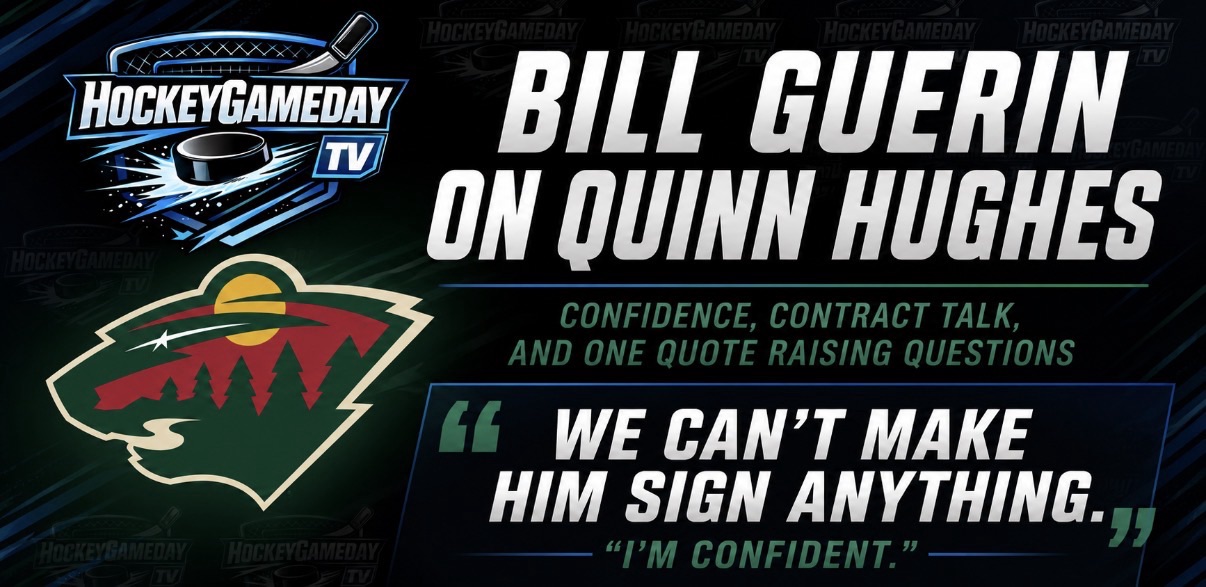
When asked about his confidence level in getting a new deal completed, Guerin didn’t hesitate.
“I’m confident.”
That’s certainly what Wild fans want to hear.
But later in the conversation came another line that immediately grabbed attention:
“We can’t make him sign anything.”
And that may perfectly summarize where Minnesota currently stands.
Guerin Says Communication With Hughes Is Strong
There doesn’t appear to be any indication of a broken relationship between Hughes and the organization.
Quite the opposite.
Guerin said the Wild maintain a “great relationship with Quinn” and also spoke positively about his relationship with Hughes’ agent, Pat Brisson. Guerin indicated that the sides remain in frequent contact and characterized the negotiations as progressing normally.
“Things are going well,” Guerin said.
Guerin has also personally remained in contact with Hughes during the offseason, seeing him in person and speaking with him over the phone. When negotiations get down to the finer contract details, however, those discussions are handled with Brisson.
That distinction is important.
There is a huge difference between a player refusing communication and a player simply taking his time before making one of the biggest decisions of his career.
So far, Guerin is publicly portraying this situation as the latter.
Why Wild Fans Are Still Nervous
The problem for Minnesota is simple: Hughes has leverage.
The 26-year-old has one season remaining on the six-year, $47.1 million contract he originally signed with the Vancouver Canucks. Unless Minnesota signs him to an extension, Hughes can become an unrestricted free agent on July 1, 2027.
And this isn’t just another good player approaching free agency.
Hughes is one of hockey’s premier defensemen.
Minnesota made an enormous commitment to acquiring him in December 2025, sending Vancouver Marco Rossi, Liam Ohgren, Zeev Buium and a 2026 first-round pick. Hughes then produced 53 points in only 48 regular-season games for the Wild and added another 15 points in 11 playoff games.
You don’t make that kind of trade with the intention of watching the centerpiece walk away less than two years later.
That’s why every Guerin comment is being dissected.
Cale Makar’s Contract Changed the Conversation
There’s another massive factor hanging over these negotiations: Cale Makar’s new contract.
Colorado recently signed Makar to an eight-year, $163.2 million extension carrying a $20.4 million annual cap hit.
That deal established a new financial benchmark for superstar NHL defensemen, and Hughes belongs in the conversation among the league’s elite players at the position.
But Guerin made an interesting point when discussing players of Hughes’ stature.
Elite stars are earning significant money much earlier in their careers than previous generations did. By the time they reach their late 20s, they may already have enough financial security that their next decision doesn’t necessarily have to revolve around squeezing every possible dollar out of a contract.
Instead, other factors can become increasingly important.
Term.
Location.
Winning.
Lifestyle.
And how a player wants the next stage of his career to look.
That’s where Guerin’s comments become particularly interesting.
Minnesota Can Plan — Hughes Still Has to Agree
Guerin explained that the Wild can build salary-cap projections several years into the future and create an organizational plan based around having Hughes on the roster.
But eventually, Hughes has to tell them what he wants.
If the player’s vision doesn’t match Minnesota’s, the Wild would have to adjust.
That isn’t necessarily Guerin signaling trouble. It’s simply the reality of negotiating with a superstar who is approaching unrestricted free agency.
Minnesota would understandably prefer to keep Hughes for as long as possible. Whether Hughes wants the maximum eight-year commitment, something shorter, or another arrangement remains the biggest unanswered question.
And until there is a signature, there will be speculation.
Guerin Has Been Here Before
Guerin also pointed toward Minnesota’s negotiations with Kirill Kaprizov as a reason not to panic.
Similar questions surrounded Kaprizov while he had one year remaining on his contract. Eventually, Minnesota secured its franchise forward on an eight-year, $136 million contract.
Guerin’s message to concerned fans is essentially that major contracts take time.
There wasn’t necessarily much urgency during June, July or August. As training camp and the regular season get closer, however, the pressure naturally begins increasing.
What Happens Next?
For now, the strongest takeaway is that there is no public evidence suggesting negotiations have collapsed.
Guerin remains confident.
Communication continues.
The relationship appears strong.
Minnesota clearly wants Hughes long-term.
But the other part of the equation cannot be ignored.
Quinn Hughes holds tremendous leverage, and the closer he gets to July 2027 without signing an extension, the louder the questions are going to become.
Guerin can create the cap space. He can offer the money. He can present Minnesota’s long-term vision.
But ultimately, he cannot force Hughes to put pen to paper.
And until that happens, every Wild fan will be watching.
What do you think — does Quinn Hughes sign a long-term extension with Minnesota, or could this situation eventually become much more complicated?