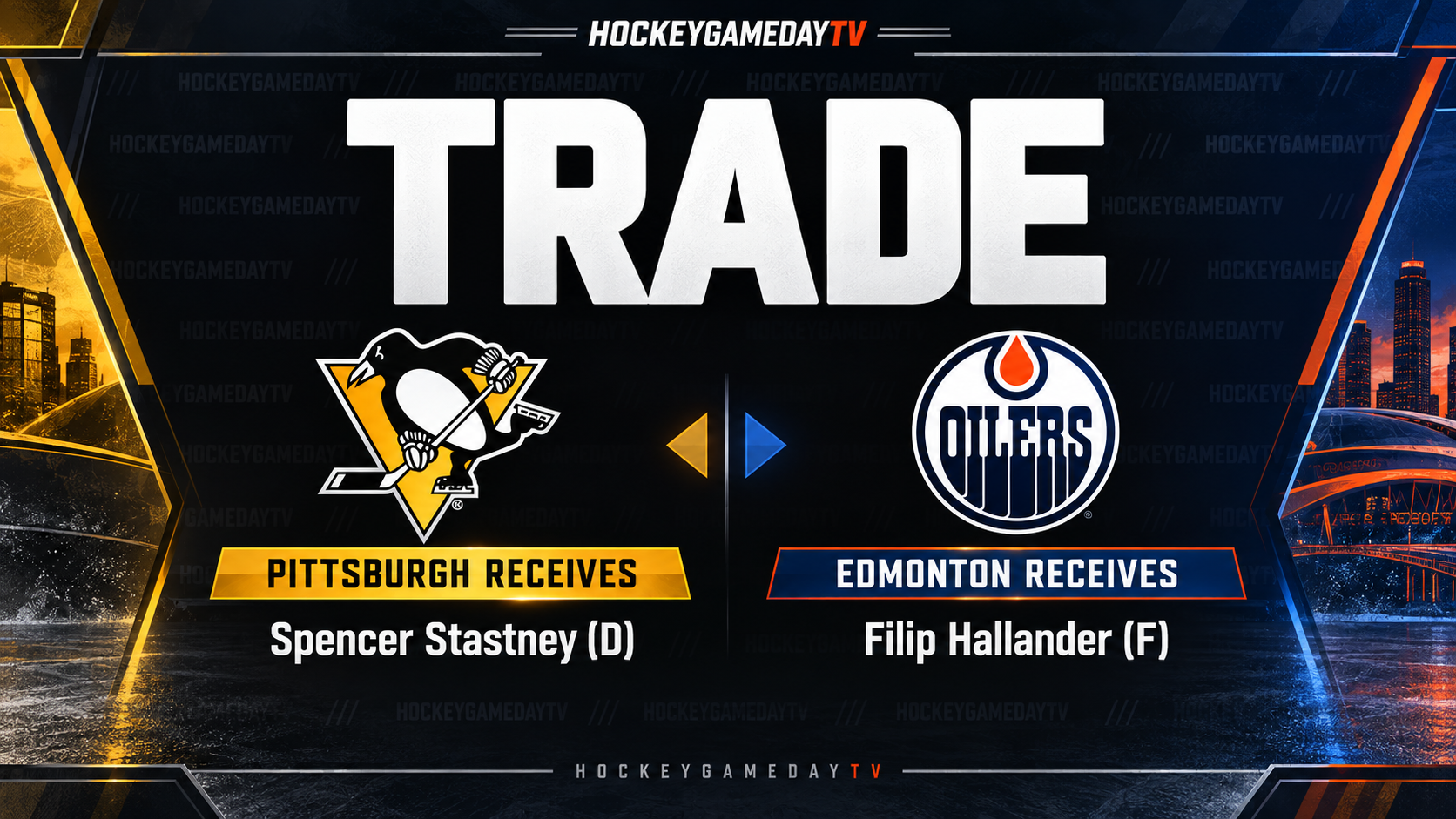
The Pittsburgh Penguins and Edmonton Oilers completed an early-season trade Wednesday, with Pittsburgh acquiring defenseman Spencer Stastney and Edmonton acquiring forward Filip Hallander.
On the surface, it is a straight one-for-one swap between two 26-year-old players. Dig a little deeper, though, and the deal addresses a different need for each club: Pittsburgh adds NHL-ready depth on defense, while Edmonton gets another versatile forward with offensive upside and a lower cap hit.
Who is Spencer Stastney?
Stastney is a 26-year-old left-shot defenseman originally selected by the Nashville Predators in the fifth round, 131st overall, of the 2018 NHL Draft.
The 5-foot-11, 196-pound blueliner is best known for his mobility, skating and ability to move the puck efficiently. He also brings penalty-killing experience, something Pittsburgh can use as it adds another dependable option to its defensive group.
Stastney had a career year in 2025-26, playing 66 games between Nashville and Edmonton while recording two goals, eight assists and 10 points. He also blocked 63 shots. Across 117 NHL regular-season games, he has four goals, 15 assists and 19 points.
How Stastney can make Pittsburgh better
This move looks less like Pittsburgh chasing offense from the blue line and more like the Penguins addressing roster balance.
Stastney gives the Penguins another NHL-capable defenseman who can skate, retrieve pucks and contribute on the penalty kill. He does not need to arrive and carry a top pairing. If he can provide reliable third-pair minutes, defend well in transition and help move the puck cleanly out of the defensive zone, Pittsburgh becomes deeper and more flexible on the back end.
He is also under contract through the 2026-27 season at a $1.525 million cap hit, so Pittsburgh knows exactly what the cost will be for the rest of the year.
Who is Filip Hallander?
Hallander may be the more intriguing offensive piece in the trade.
The Swedish forward was originally selected by Pittsburgh in the second round, 58th overall, of the 2018 NHL Draft. Edmonton lists him at 6-foot-2 and 207 pounds, giving the Oilers another forward with size who can play a responsible two-way game.
Hallander’s North American NHL sample is still relatively small, but his production in Sweden showed what his offensive ceiling could look like. With Timra IK in 2024-25, he scored 26 goals and 53 points in 51 games. Both totals ranked second in the SHL, and his 53 points established a Timra single-season record.
He also produced in the AHL, recording 62 points in 107 games with Wilkes-Barre/Scranton.
Hallander had started the 2026-27 season well in Pittsburgh, recording one goal and two assists with a plus-4 rating through two games before the trade. He now has seven points in 18 career NHL games.
How Hallander can make Edmonton better
The timing makes plenty of sense for Edmonton. The Oilers have been dealing with injuries up front, so adding another NHL-ready forward gives the coaching staff more options immediately.
Hallander does not need to become a star to make this trade work. Edmonton already has elite offense at the top of the lineup. What the Oilers need is useful depth behind it — players who can support the puck, defend responsibly and still contribute when opportunities come.
Hallander’s two-way game, size and production in Sweden make him an interesting bet for a bottom-six role with room to grow. At 26, he is also still young enough that Edmonton may be getting him just as he is beginning to establish himself as a full-time NHL player.
The financial side also matters. Hallander carries an $850,000 cap hit for 2026-27, compared with Stastney’s $1.525 million. That gives Edmonton roughly $675,000 in additional cap flexibility while still adding a player who can help its current lineup.
Who won the trade?
It is difficult to declare a clear winner immediately because the two teams were shopping for different things.
Pittsburgh gets the more established NHL player. Stastney has already shown he can handle regular-season minutes and contribute on the penalty kill, making him an easier player to project into the Penguins’ lineup.
Edmonton gets the player with more offensive upside — and some extra cap room. Hallander’s strong SHL production, encouraging start this season and two-way profile make him a worthwhile gamble for a contender looking for more options up front.
For now, this looks like one of those trades that could genuinely help both teams because each club dealt from one area to address another.
HockeyGamedayTV early trade grade:
Pittsburgh Penguins: B
Edmonton Oilers: B+
Edmonton gets the slight edge because Hallander’s upside and lower cap hit could become especially valuable if he turns his strong early-season start into a permanent NHL role.
Sources
- Pittsburgh Penguins trade release
- Edmonton Oilers trade release
- Penguins: Hallander signing and SHL background
- PuckPedia: Hallander contract details