There is a difference between broadcasting hockey and controlling hockey.
For decades, Canadians did not need to think about which corporation owned the national rights, which streaming subscription carried Wednesday’s game or whether their city would still have a local sports radio station next season. Hockey was simply there. It was on CBC every Saturday night, on the radio during the drive home and discussed by familiar broadcasters who became almost as recognizable as the players.
Under Rogers, that relationship is disappearing.
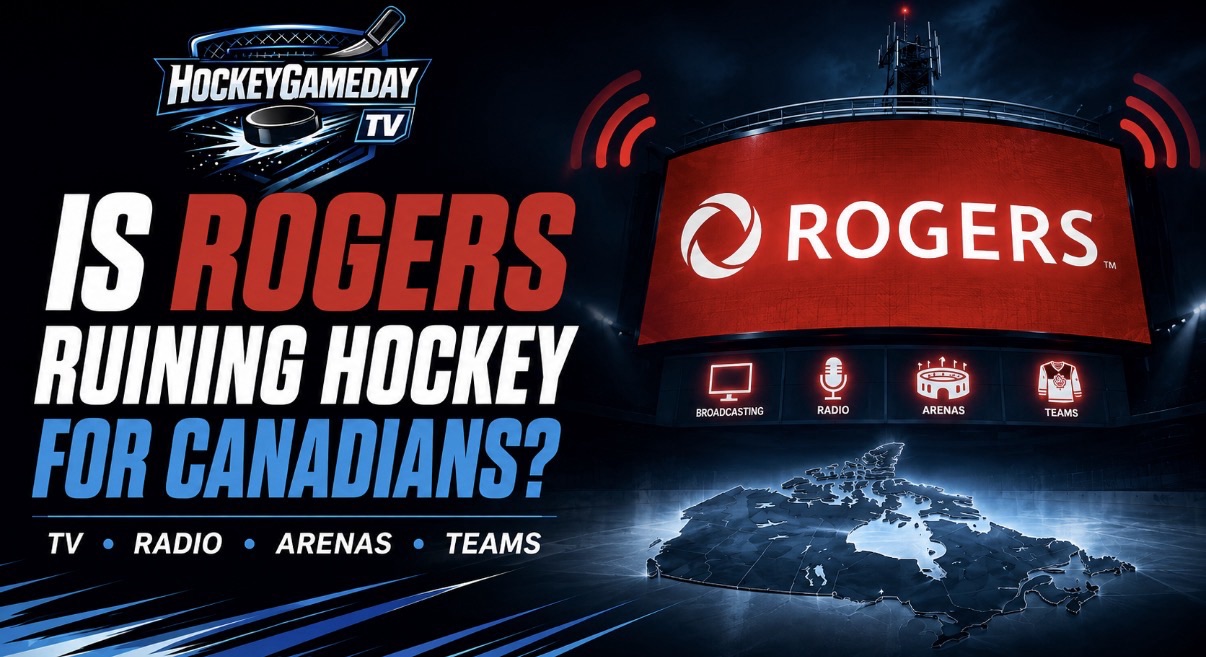
The company is no longer merely one of several broadcasters covering Canada’s game. It controls the national NHL rights, owns the country’s largest sports network, holds regional television agreements with several Canadian teams, has its name attached to major NHL arenas and is moving toward complete ownership of the Toronto Maple Leafs and Maple Leaf Sports & Entertainment.
That amount of control should concern every Canadian hockey fan.
More money, but less access
Rogers first secured Canada’s national NHL rights in 2013 through a 12-year agreement worth $5.2 billion. That deal began with the 2014–15 season and transformed Sportsnet into the primary gatekeeper for nationally televised NHL hockey in Canada.
Instead of opening the market to greater competition when that agreement expired, the NHL doubled down.
In April 2025, Rogers and the league announced another 12-year agreement worth $11 billion. Beginning in 2026–27, Rogers will control the national rights on television, digital and streaming platforms through the end of the 2037–38 season.
Rogers CEO Tony Staffieri was remarkably direct about the company’s motivation.
“Sports are core to our company, and these rights are the most valuable sports rights in Canada,” he said when the deal was announced. (NHL)
That statement tells Canadians everything they need to know. Hockey may be Canada’s game to the fans, but to Rogers, it is an extraordinarily valuable corporate asset.
The new agreement promises more nationally available games and fewer regional blackouts. Those would be legitimate improvements. But improved scheduling does not erase the larger issue: one telecommunications company will decide where Canadians can watch the NHL, how much access costs and which platforms receive the most attractive games for another 12 years.
The end of free Hockey Night in Canada
The most symbolic loss came in June 2026, when Rogers and CBC announced that NHL games would no longer air on the public broadcaster.
Hockey Night in Canada had been shown on CBC television since 1952. Under the previous rights agreement, Rogers produced the broadcasts, controlled the editorial presentation and managed the advertising, while CBC provided free, over-the-air access to millions of Canadians.
That arrangement ended after the 2025–26 season.
CBC Sports executive director Chris Wilson called it “a bit of an end of an era” and acknowledged that the decision would “take an opportunity away from some Canadians to see it on CBC.” (AP News)
Rogers-owned Citytv will also stop carrying national NHL games. That means the 2026–27 season will begin without national NHL games on free, conventional television in Canada.
At the same time, Rogers has signed a new 12-year sublicensing agreement with Amazon. Prime Video will exclusively carry at least 26 Wednesday-night games each season, along with two first-round playoff series and one second-round series annually.
The games are included for Prime subscribers, but Canadians who do not already subscribe are being pushed toward another paid platform. Hockey is moving away from universally available television and deeper into a collection of specialty channels and subscription services. (AP News)
Former Hockey Night host Dave Hodge described the erosion of the program’s identity perfectly, saying modern hockey broadcasts have become “almost indistinguishable” because “they all look the same.” (AP News)
Rogers is shutting down the conversations around hockey
The damage is not limited to television.
On July 7, 2026, Rogers announced it was cutting 230 positions across its sports and media division. Eighty employees were connected to the closure of six radio stations in Vancouver, Calgary, Halifax and Kitchener.
The shutdowns included Sportsnet 650, Vancouver’s last remaining all-sports radio station, and Sportsnet 960 in Calgary.
Sportsnet said declining advertising revenue and changing audience habits had created “headwinds,” adding that the company was focusing its investments on areas expected to “drive growth long-term.” (Broadcast Dialogue)
That explanation may satisfy a quarterly financial report. It does little for the people who depended on those stations.
Sports radio is more than a game broadcast. It is where fans debate trades, criticize management, hear from local reporters and connect with their team throughout an 82-game season. National television panels cannot replace hours of daily discussion built specifically for Vancouver or Calgary.
Canucks radio broadcasts are being moved to another Rogers-owned station. Rogers, however, is stepping away from producing Calgary Flames radio broadcasts entirely, leaving the organization to find another arrangement. (Global News)
B.C. Premier David Eby called the closures “a blow for British Columbians,” arguing that local journalism is more important than profits. (Global News)
The timing made the cuts look even worse. One day before announcing the radio closures, Rogers revealed an agreement to spend $4.35 billion purchasing the remaining 25 per cent of MLSE that it did not already control.
The message received by many fans was difficult to ignore: Rogers can find billions to expand its sports empire, but not enough to preserve local radio stations and the jobs attached to them.
Familiar voices keep disappearing
Kelly Hrudey became the latest familiar hockey personality to be shown the door when he revealed in August 2026 that Sportsnet would not renew his contract.
Hrudey had been part of Hockey Night in Canada for nearly three decades and worked full-time under Sportsnet’s national coverage since 2014. He was not simply another interchangeable studio analyst. He was a familiar voice who brought goaltending experience, emotion and a genuine connection to the history of the program. (Daily Hive)
His departure follows years of high-profile changes.
Bob McCown’s three-decade run at Rogers ended in 2019, despite Rogers itself calling him “an icon” and “a legend of our format.” McCown made it clear he was not retiring, writing that nobody could shut him up while he still had something to say. (Sportsnet.ca)
That same year, Nick Kypreos departed after 21 years with Sportsnet. Doug MacLean and John Shannon also parted ways with the network during the same restructuring. Kypreos eventually returned in a different role, but the original departures dismantled one of the network’s most recognizable hockey groups. (Sportsnet.ca)
Glenn Healy and P.J. Stock were among earlier cuts to the national hockey operation in 2016. Christine Simpson’s lengthy Sportsnet run ended in 2024. Other departures have occurred for different and sometimes serious reasons, including Don Cherry’s 2019 firing following remarks Sportsnet described as divisive. It would be misleading to pretend every exit was financially motivated or undeserved.
But the larger pattern remains: recognizable personalities disappear while the corporation controlling the product becomes more powerful.
From television screens to teams and arenas
Rogers’ reach no longer ends when the broadcast signs off.
The company currently owns 75 per cent of MLSE after completing its $4.7-billion purchase of Bell’s stake in July 2025. MLSE owns the Maple Leafs, Toronto Marlies, Raptors, Argonauts and Toronto FC, while also owning and operating Scotiabank Arena.
Rogers has since agreed to purchase Kilmer Sports’ remaining 25-per-cent interest for $4.35 billion. The transaction is expected to close after the necessary approvals, which would make Rogers the sole owner of MLSE. (About Rogers)
Rogers does not own the Vancouver Canucks or Edmonton Oilers, but its presence surrounds both franchises. It holds the naming rights to Rogers Arena in Vancouver and Rogers Place in Edmonton. Sportsnet is also the regional television broadcaster for the Canucks, Oilers, Flames and Maple Leafs. (About Rogers)
That creates an extraordinary chain of influence.
The company sells Canadians their internet and television services. It owns the network carrying the games. It controls the national media rights. It holds several regional rights. It licenses games to streaming platforms. It owns most of the Maple Leafs and is seeking full control. It owns the arena in which the Leafs play through MLSE. Its name is displayed on the home buildings of the Canucks and Oilers.
Rogers calls this investment.
Fans are entitled to call it concentration.
Canada’s game deserves more than one gatekeeper
Rogers has invested enormous amounts of money in Canadian sports. Its broadcasts employ talented reporters, producers, technicians and commentators. The company is not solely responsible for declining radio audiences, rising sports-rights costs or the global migration toward streaming.
But investment does not excuse the steady removal of alternatives.
A healthy Canadian hockey landscape should include free national broadcasts, strong local radio, competing voices and meaningful separation between the company that owns a team, the network that covers it and the corporation that controls the league’s national rights.
Instead, Canadians are watching one company accumulate control over nearly every part of the hockey experience while local outlets close and familiar voices disappear.
Rogers may be building an extremely profitable sports empire.
It is also taking something that once belonged to the entire country and placing more of it behind corporate walls.