
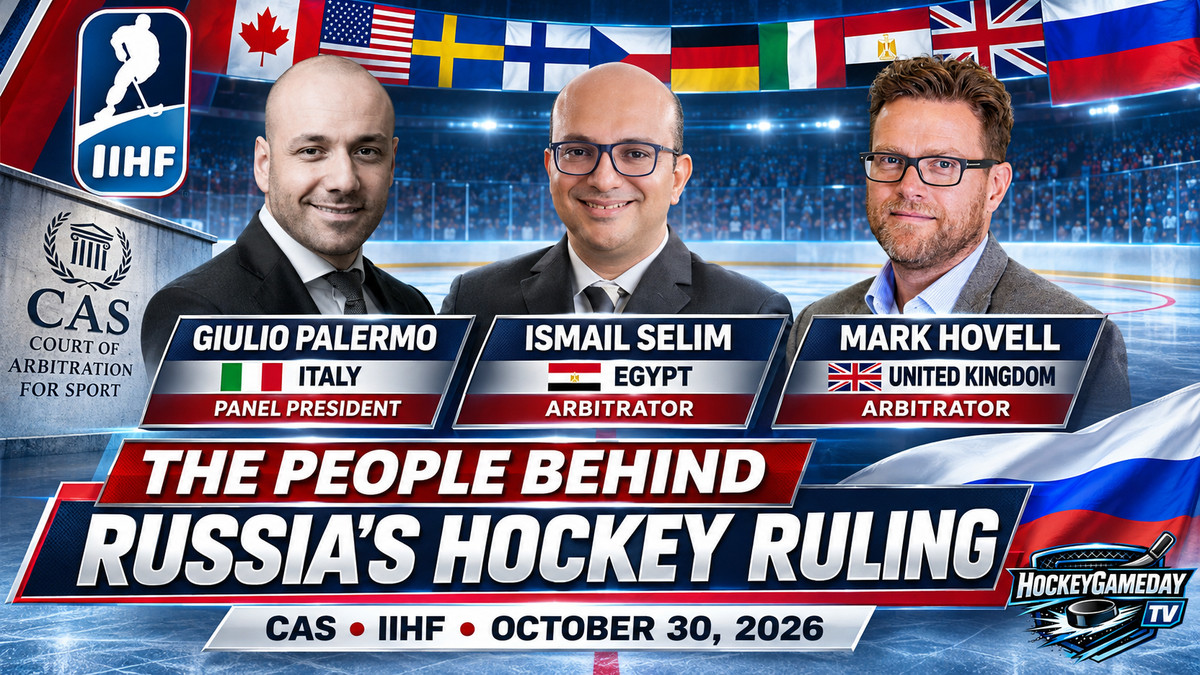
Three arbitrators from Italy, Egypt and the United Kingdom have delivered one of international hockey’s most contentious decisions in years. Now, questions are growing about who these men are, how they were chosen and why they overturned Russia’s exclusion.
By HockeyGamedayTV | November 6, 2026
For more than four years, Russia has been absent from International Ice Hockey Federation (IIHF) competitions following its February 2022 invasion of Ukraine. That changed dramatically on October 30, 2026.
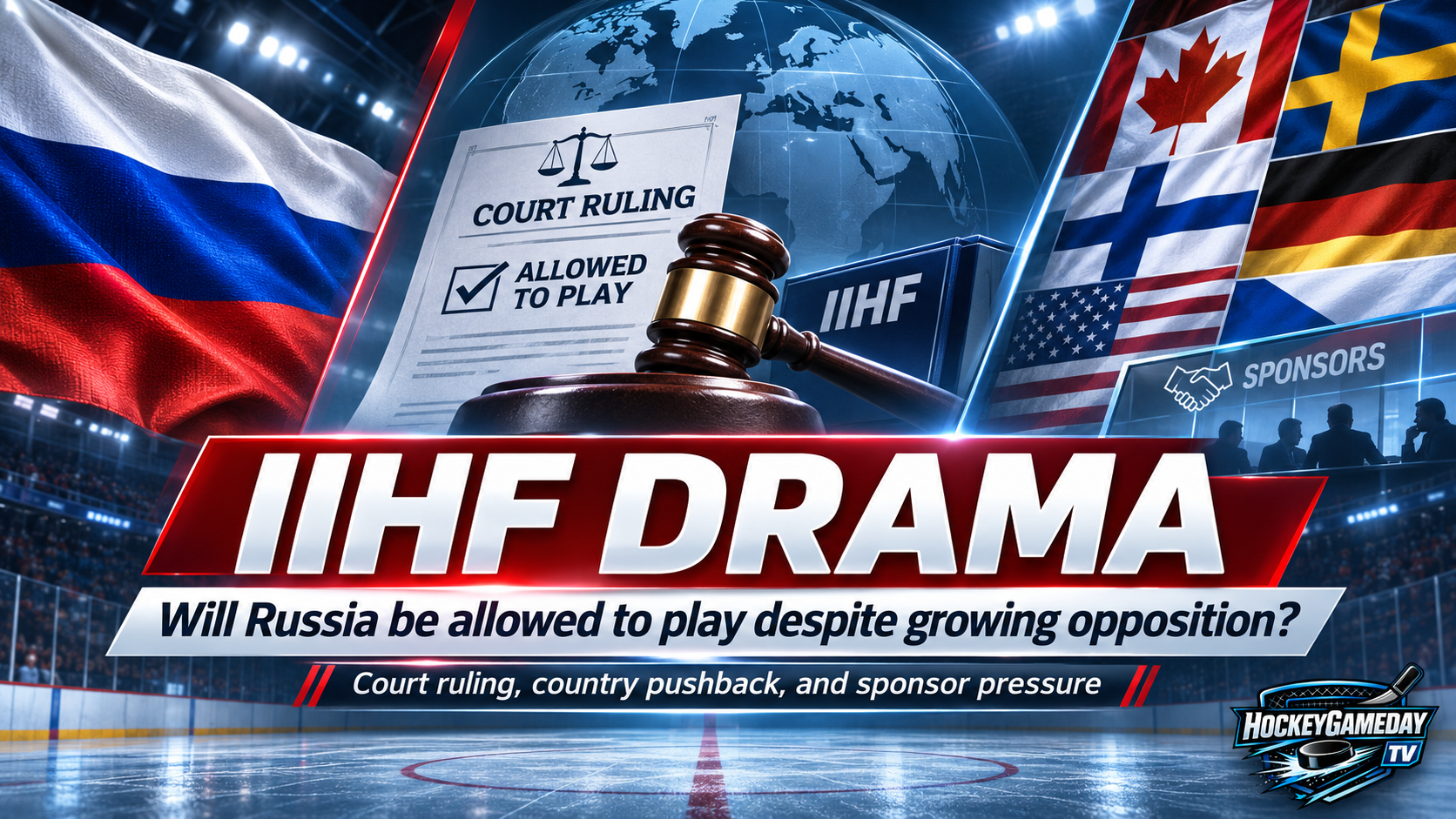
A three-member Court of Arbitration for Sport (CAS) panel, hearing an appeal by the Russian Ice Hockey Federation against the IIHF, unanimously ruled that Russia’s continued exclusion had not been sufficiently justified under the applicable IIHF rules.
The decision triggered a fierce international reaction. Several European hockey federations say they will not compete against Russia. Canada has declared that Russian teams will not be permitted to take part in the upcoming World Junior Championship in Alberta. The IIHF itself continues to object to immediate reinstatement.
But who are the three individuals responsible for the ruling? Who selected them? And what exactly did they decide?
Giulio Palermo: The Italian lawyer who chaired the panel
Country: Italy | Role: President of the CAS arbitration panel
Giulio Palermo is a Geneva-based international arbitration lawyer qualified in Switzerland, Italy and Spain. His professional biography credits him with more than 100 international arbitration proceedings, including over 60 appointments as arbitrator. He founded GPA Law in 2026.
One detail of his background stands out: Palermo also serves as an Ethics and Disciplinary Inspector for UEFA, European football’s governing body. In that capacity he represents UEFA in disciplinary and appeal proceedings. He therefore has first-hand experience with the rules and procedures of a major sports governing organization.
As president of the three-person panel, Palermo chaired the case. That position did not give him an additional vote. And his role in the Russia case does not establish that he personally supports reinstatement on political or moral grounds.
Ismail Selim: The former Egyptian judge
Country: Egypt | Role: Arbitrator
Ismail Selim is a former Egyptian judge and public prosecutor who went on to specialize in international arbitration. He served as director of the Cairo Regional Centre for International Commercial Arbitration, and his professional background includes academic work at Paris 1 Panthéon-Sorbonne.
Unlike a former hockey executive, Selim comes primarily from the worlds of legal evidence, procedure and international dispute resolution. That is not unusual at CAS: arbitrators are asked to interpret rules and assess whether the parties have met the applicable legal standards.
Here is the striking reported detail: according to Czech newspaper iDNES, Selim was nominated to the panel by the IIHF itself. If that account is correct, an arbitrator chosen by the IIHF was among those who unanimously found the federation had not adequately demonstrated its case.
That does not make Selim an IIHF representative. Party-appointed CAS arbitrators have a duty to remain independent and impartial.
Mark Hovell: The British sports lawyer reportedly nominated by Russia
Country: United Kingdom | Role: Arbitrator
Mark Hovell is a sports lawyer and partner at Mills & Reeve, based in Manchester. He has worked in sports law for decades, with experience in club governance, contracts, disciplinary proceedings, insolvency and arbitration.
His CAS history is especially extensive: published professional biographies say he has been selected to hear more than 200 CAS matters. He has also been involved in major-event arbitration panels and is accredited to the United Kingdom’s National Anti-Doping Panel.
According to the same November 2 iDNES interview, Hovell was nominated by the Russian Ice Hockey Federation. That is an important detail about the reported appointment process, but it is not evidence that Hovell acted on Russia’s instructions. An arbitrator nominated by one party must still decide the dispute impartially.
Who selected the three arbitrators?
Czech sports-law expert and former CAS arbitrator Jan Šťovíček discussed the reported panel selection in an interview published by iDNES on November 2. According to that reporting:
- Mark Hovell (United Kingdom): Reportedly nominated by the Russian Ice Hockey Federation.
- Ismail Selim (Egypt): Reportedly nominated by the IIHF.
- Giulio Palermo (Italy): Appointed as the independent president of the panel by CAS leadership.
Important qualification: CAS’s public announcement confirms all three panel members, but the specific nominations above are attributed to Czech reporting, not to a published CAS appointment record.
Why did all three rule in Russia’s favour?
The central legal question was not whether the arbitrators approved of Russia’s invasion of Ukraine, or whether they personally wanted Russian teams to return. It was whether the IIHF had demonstrated sufficient justification, under its own regulations, to continue excluding Russian teams.
According to CAS, the IIHF’s arguments citing safety, security and related concerns were not supported by sufficient evidence. The arbitrators noted that concerns about the adequacy of the justification had previously arisen within the IIHF’s own disciplinary process.
The panel unanimously concluded that, under the applicable regulations, sufficiently substantiated security concerns were required to outweigh participation rights. Because the IIHF had not met that legal threshold in the panel’s assessment, Russia’s appeal succeeded.
That is a crucial distinction: CAS did not announce that bringing Russia back would be risk-free. It found that the IIHF had not sufficiently established the legal grounds for continued exclusion on the evidence presented.
Nor do we have separate explanations from Palermo, Selim and Hovell stating their individual motivations. As of November 6, CAS has said the full written award, setting out the parties’ arguments and detailed legal reasons, will be published as soon as possible.
CAS defends its ruling as the backlash grows
On November 5, CAS responded to the divisive reaction by emphasizing that arbitration decisions must be made on the legal arguments and evidence submitted by the parties. It also said proposed alternatives—such as a neutral-status arrangement for Russian athletes—had not been sought or sufficiently substantiated for the panel to impose.
The IIHF has publicly disagreed. Its October 30 and November 4 statements warn that immediate reintegration creates serious practical problems involving visas, entry requirements, tournament formats, security, travel, accommodation and the limited time available before some events begin.
The disagreement is now about more than legal eligibility. It is also about whether and how a decision can be implemented when host countries, national hockey organizations and sponsors object.
Canada says Russia will not play at the 2027 World Juniors
The 2027 World Junior Championship is scheduled to begin on December 26, 2026, in Edmonton and Red Deer, Alberta. Canadian Prime Minister Mark Carney stated on November 3 that Russian players would not be permitted to compete at the event.
Other national federations—including Finland, Sweden, Czechia and several others—have said they will refuse to face Russia under current conditions. International sponsors have also raised concerns about their continued involvement.
That leaves the hockey world in an extraordinary position: CAS has ruled on Russia’s eligibility, but a sports arbitration decision cannot by itself grant a team entry into a host country or force other national teams to take the ice.
The 2022 football comparison raises another question
This is not the first time CAS has ruled on Russia’s exclusion from international sport. In July 2022, it upheld FIFA and UEFA decisions to bar Russian football teams, after considering the extraordinary circumstances arising from the war and the international response.
In October 2026, a different CAS panel reached a different outcome involving international hockey. That contrast is worth examining, but it does not automatically establish inconsistency or improper conduct: different federations, regulations, claims and evidence can produce different legal outcomes.
The eventual written hockey award should clarify precisely why the IIHF’s proof failed to satisfy the three arbitrators.
Five international championships are affected
According to the IIHF, the decision concerns Russia’s potential participation in the following 2027 events:
- IIHF Men’s World Championship
- IIHF World Junior Championship
- IIHF Women’s World Championship
- IIHF Under-18 Men’s World Championship
- IIHF Under-18 Women’s World Championship
The IIHF is consulting national associations, organizers and host authorities about how to respond to the ruling. Whether Russia will actually play in those tournaments remains unsettled.
The bigger question: Who has the final say?
Two principles are now colliding. Sporting organizations must apply their rules fairly and justify restrictions on participation. At the same time, they are responsible for safety, security and the functioning of their competitions.
CAS concluded that the IIHF’s evidence had not met the applicable legal test. The IIHF disagrees with the practical implications. National governments and hockey federations retain their own powers and responsibilities.
The three arbitrators—Giulio Palermo, Ismail Selim and Mark Hovell—have made their unanimous decision. But this may be only the beginning of the dispute over Russia’s possible return to international hockey.
When an international sports tribunal overturns a federation’s decision, but the countries expected to host and compete reject the outcome, who ultimately controls the tournament?
HockeyGamedayTV wants to hear from you: Should CAS have the power to overturn the IIHF’s exclusion, or should the participating hockey nations have greater influence? Share your thoughts in the comments.
Sources and further reading
- IIHF — October 30 statement on the CAS ruling
- IIHF — November 4 follow-up statement
- CAS — October 30 ruling summary (reproduced by Sports Law and Taxation)
- CAS — November 5 clarification (reproduced by Valloni)
- GPA Law — Giulio Palermo biography
- Mills & Reeve — Mark Hovell biography
- iDNES — November 2 interview concerning panel selections
- Canadian Press / Sportsnet — November 5 report on CAS reaction
Reporting current to November 6, 2026. Panel-selection details attributed to iDNES are reported rather than independently confirmed by a CAS appointment record. HockeyGamedayTV — Your Game. Your Voice.


Leave a Reply