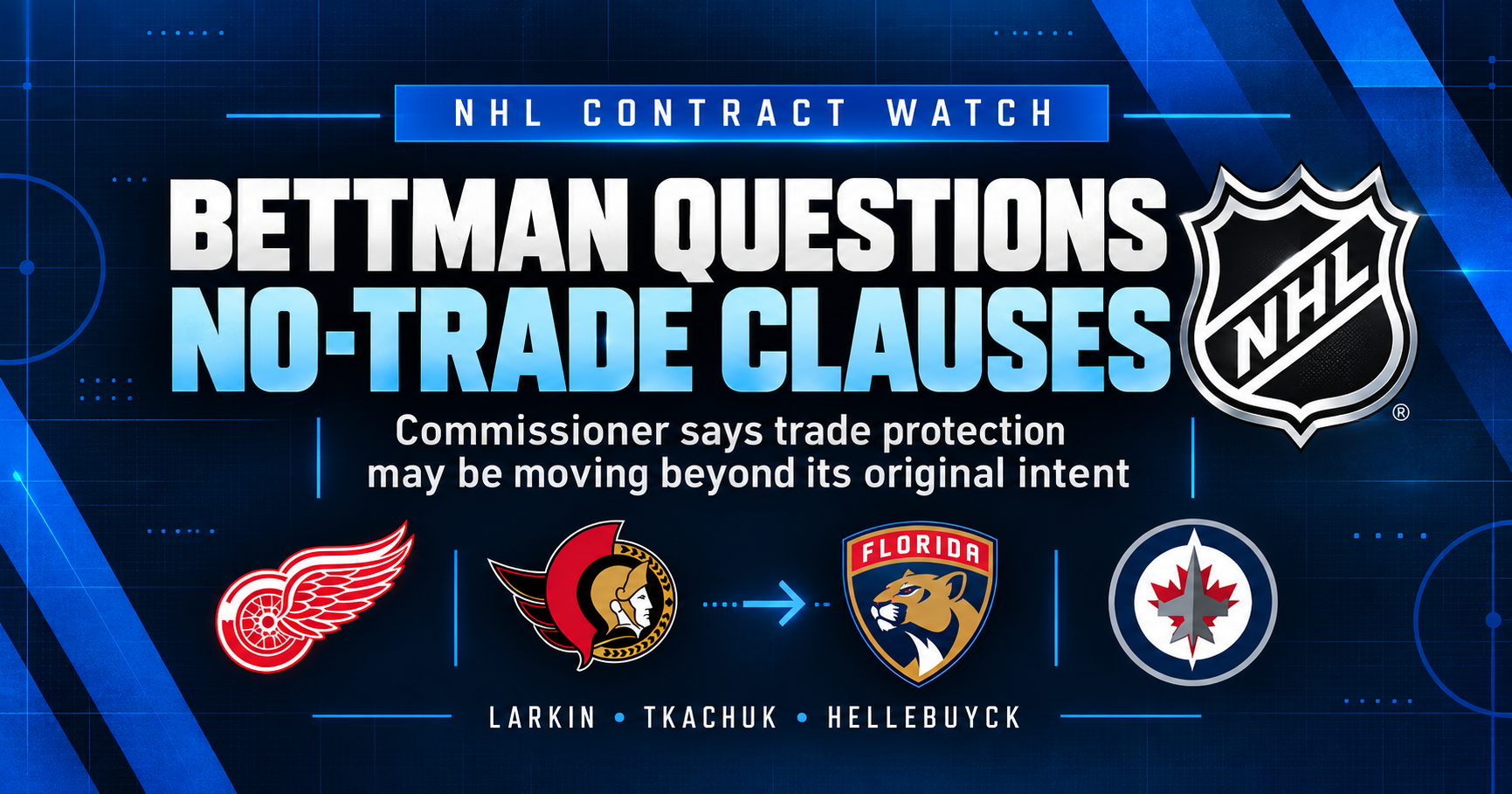
NHL Commissioner Gary Bettman is questioning whether no-trade and no-movement clauses are being used the way they were originally intended after a summer that saw several star players request trades while holding significant control over where they could go.
Bettman addressed the issue Thursday during an appearance on Sportsnet’s FAN Hockey Show, pointing to a noticeable shift in how movement protection is being used around the league. His comments come after high-profile trade requests involving Dylan Larkin, Brady Tkachuk and Connor Hellebuyck — three players who all had full no-movement protection in their contracts.
Bettman says the original purpose may be changing
Bettman explained that no-trade and no-movement clauses were originally designed to provide security to players who made long-term commitments to a specific organization. In some cases, a player might accept less money to remain in a city or with a team, and movement protection would help ensure that commitment was respected.
“As I look at what’s happened or is happening now, I don’t think that’s a good thing.”
Gary Bettman on Sportsnet’s FAN Hockey Show
According to Sportsnet, Bettman specifically questioned a modern dynamic in which a player can request a trade and then use contractual protection to determine which teams are acceptable destinations.
That distinction is important. Bettman did not announce a rule change, nor did he say the NHL is immediately seeking to eliminate no-trade or no-movement clauses. Instead, he said the league intends to watch the trend and could eventually discuss it with the NHL Players’ Association if it develops into a broader problem.
Why Dylan Larkin’s situation matters
Dylan Larkin requested a trade from the Detroit Red Wings following the 2025-26 season. Former general manager Steve Yzerman confirmed the request in June and said Larkin had supplied Detroit with a short list of teams he would consider.
Larkin is signed long term and has a full no-movement clause, meaning Detroit cannot simply send him anywhere it chooses. Sportsnet reported in late September that Larkin had expanded the number of destinations he would consider to roughly eight teams, potentially giving the Red Wings more options while still leaving the player with considerable control over the process.
The 30-year-old has spent his entire NHL career with Detroit and served as captain for six seasons. The Red Wings removed the “C” ahead of training camp after his trade request. NHL.com reported that Larkin still planned to report and remain professional while the organization worked through the situation.
Brady Tkachuk used his leverage before joining Florida
Brady Tkachuk’s offseason move became one of the biggest trades of 2026. The Ottawa Senators sent their captain to the Florida Panthers in June after Tkachuk requested a move, reuniting him with his older brother Matthew.
Ottawa received the No. 9 and No. 25 picks in the 2026 NHL Draft, a 2027 second-round pick and a conditional 2029 first-round pick. Tkachuk had two seasons remaining on his contract at the time of the deal.
The trade was possible because Ottawa and Tkachuk ultimately found a destination that worked for both sides. But from Bettman’s perspective, the situation is another example of how a player can combine a trade request with contractual movement protection to influence the outcome. NHL.com detailed the full trade package after the deal was completed.
Connor Hellebuyck’s standoff with Winnipeg goes even further
Connor Hellebuyck’s situation with the Winnipeg Jets has become the most dramatic of the three.
The three-time Vezina Trophy winner publicly confirmed on August 27 that he had requested a trade months earlier. Hellebuyck said he believed moving on from Winnipeg was the best path for himself and his family. He later did not report to training camp and was suspended by the Jets.
Winnipeg has continued to listen to offers, but the club has also made clear it will not move one of the NHL’s top goaltenders simply for the sake of resolving the situation. Hellebuyck’s full no-movement protection gives him substantial say over any potential destination, creating a difficult negotiating environment for the Jets.
NHL.com reported that Hellebuyck originally tried to keep the request private before making it public as training camp approached.
What is the difference between a no-trade clause and a no-movement clause?
Both clauses are individually negotiated forms of player protection, but they are not identical.
- No-trade clause (NTC): Can restrict or prevent a team from trading a player without the player’s consent. Some are full clauses, while others allow players to submit lists of teams they will or will not accept.
- No-movement clause (NMC): Provides broader protection and can prevent involuntary relocation by trade, loan or waiver claim.
The NHL’s Collective Bargaining Agreement allows eligible players and teams to negotiate these protections into contracts. The league and NHLPA’s new CBA took effect on September 16, 2026 and runs through September 15, 2030. The agreement also includes new procedures surrounding the filing of trade lists, but the basic concept of negotiated movement protection remains in place.
Could the NHL change no-trade rules?
Possibly — but Bettman made clear the league is not there yet.
He said one offseason is not enough to declare the situation a league-wide problem. If the trend continues, however, the issue could eventually become a subject of discussion between the NHL and NHLPA.
Any meaningful change would likely involve collective bargaining because no-trade and no-movement protection is part of the contractual framework negotiated between the league and the players’ association. That means the NHL could not simply erase those rights from existing contracts on its own.
The bigger question: how much control should stars have?
This debate goes beyond Larkin, Tkachuk or Hellebuyck. NHL teams increasingly commit major money and term to star players, and movement protection can be an important part of convincing those players to sign long-term contracts.
From the player’s perspective, a no-movement clause is a negotiated contractual right. From a team’s perspective, a trade request can become far more complicated when the same player controls most or all of the acceptable destinations. Fewer potential trade partners can reduce leverage and make it harder for a club to receive the return it believes a star player is worth.
Bettman’s comments suggest the NHL is now watching closely to see whether the summer of 2026 was an unusual cluster of high-profile cases or the beginning of a larger change in player-team relationships.
What do you think? Should players who negotiate full no-trade or no-movement protection be able to request a trade and still control the list of destinations, or should requesting a move change how that protection works?
Related HockeyGamedayTV coverage: How no-trade clauses changed the NHL trade market · Dylan Larkin’s trade situation explained · Brady Tkachuk trade-request timeline
Sources: Sportsnet, NHL.com, NHL/NHLPA Collective Bargaining Agreement.