Updated for the 2026-27 NHL season and the 2027 offseason rules. A qualifying offer is the mechanism an NHL team uses to keep the negotiating rights to an eligible restricted free agent after his contract expires.
What is an NHL qualifying offer?
A qualifying offer — often shortened to QO — is a one-year contract offer that a team must tender to an eligible RFA by the CBA deadline if it wants to preserve that player’s restricted free-agent rights.
If the club does not make the required qualifying offer, the player can become an unrestricted free agent and sign with another team without the former club receiving offer-sheet compensation.
The qualifying-offer formula changes in 2027
Beginning with the 2027 offseason, the new NHL/NHLPA rules use these qualifying-offer thresholds:
| Most recent salary | Required qualifying offer |
|---|---|
| $1.25 million or less | 110% |
| More than $1.25M but less than $1.75M | 105% |
| $1.75M or more | The lesser of 100% of most recent salary or 120% of cap hit |
These are important changes from the formula used through the summer of 2026, so older qualifying-offer examples can be misleading when discussing 2027 RFAs.
Does the player have to accept the qualifying offer?
No. The qualifying offer is primarily what preserves the club’s RFA rights. The player can reject it and continue negotiating a different contract. Depending on eligibility, salary arbitration or an offer sheet may also be options.
When is a qualifying offer due?
Under the CBA, teams must generally tender qualifying offers by the later of June 25 or the first Monday after the NHL Entry Draft. The league publishes the exact date each offseason.
In 2026, qualifying offers were due June 29 at 5 p.m. ET. They could not be accepted before July 1 and normally expired July 15 unless the club extended the acceptance period in writing.
What happens if the team does not qualify the player?
The biggest consequence is that the team can lose control of the player’s rights. A non-qualified RFA becomes eligible for unrestricted free agency, where he can negotiate with the entire league.
Qualifying offer vs offer sheet
They are completely different. A qualifying offer comes from the player’s current team to preserve RFA rights. An offer sheet comes from another NHL club trying to sign an eligible RFA. If an offer sheet is signed, the original team receives the right to match and can receive draft-pick compensation if it declines.
Why teams sometimes walk away from an RFA
- The required QO is more than the team believes the player is worth.
- The club wants to open a roster or contract slot.
- The player could have arbitration rights that create additional salary risk.
- The team prefers to negotiate after allowing the player to reach the open market.
More HockeyGamedayTV explainers
Read our guides to RFA vs UFA and NHL offer sheets to see what can happen after a qualifying offer is made.
Rule references: PuckPedia’s Restricted Free Agents & Qualifying Offers guide and the NHL/NHLPA CBA.
More NHL rules explained: Visit the HockeyGamedayTV NHL Explainer Library for guides to contracts, free agency, waivers, LTIR, trades and the salary cap.
Practical fan scenario — November 2026
What a qualifying offer does—and doesn’t—settle
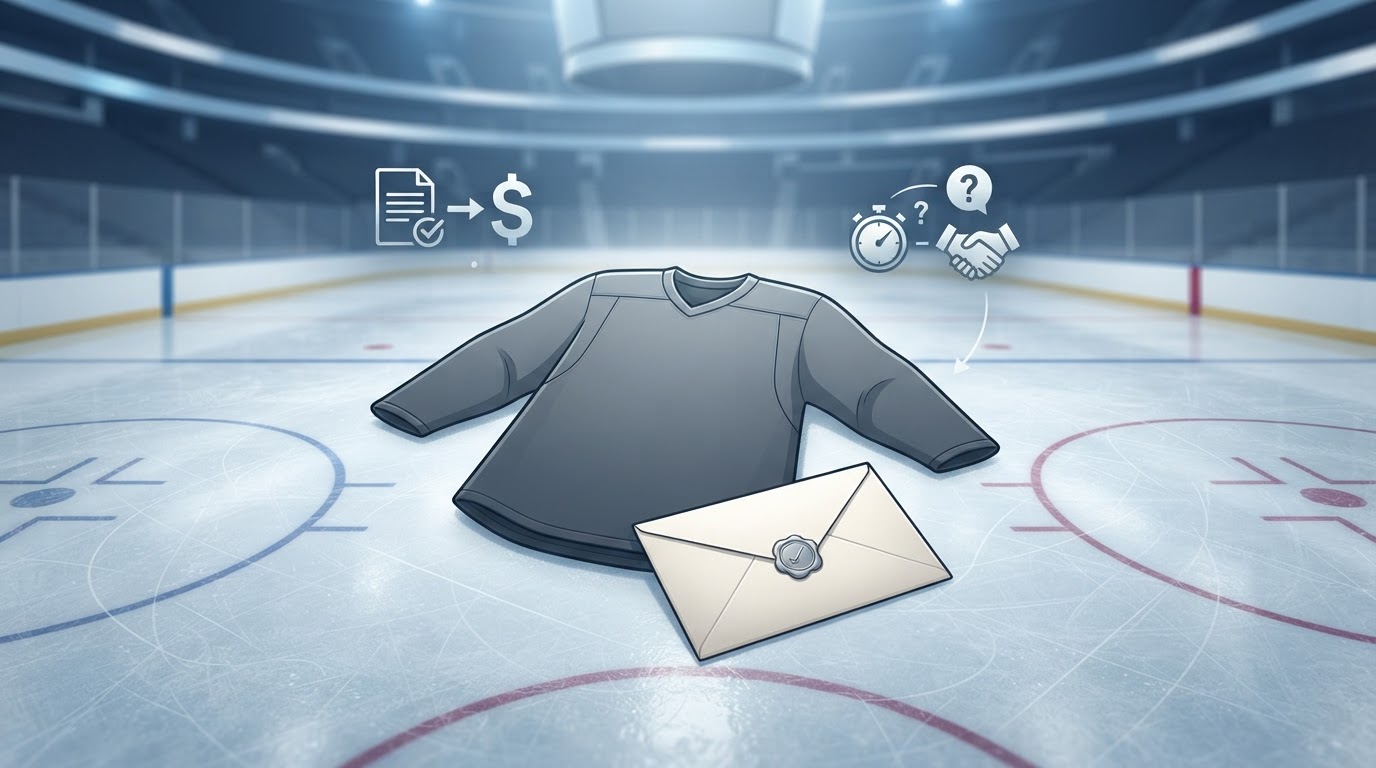
A qualifying offer is best understood as a tool for retaining negotiating rights, not proof that the player and club have agreed on a long-term deal. Picture a young forward whose contract expires: the team can make the required qualifying offer by the deadline and continue negotiating. The player might ultimately accept the one-year offer, agree to different terms, pursue arbitration if eligible, or explore other rights provided under the CBA.
Before calling a player “unsigned but controlled,” check his actual restricted-free-agent status, whether the club tendered a qualifying offer, and the applicable year’s rules. Different offseason windows can change the player’s options. The NHL and NHLPA collective bargaining agreement resources are the primary reference for rights and deadlines; this simplified example isn’t legal advice or a claim about a current negotiation.