
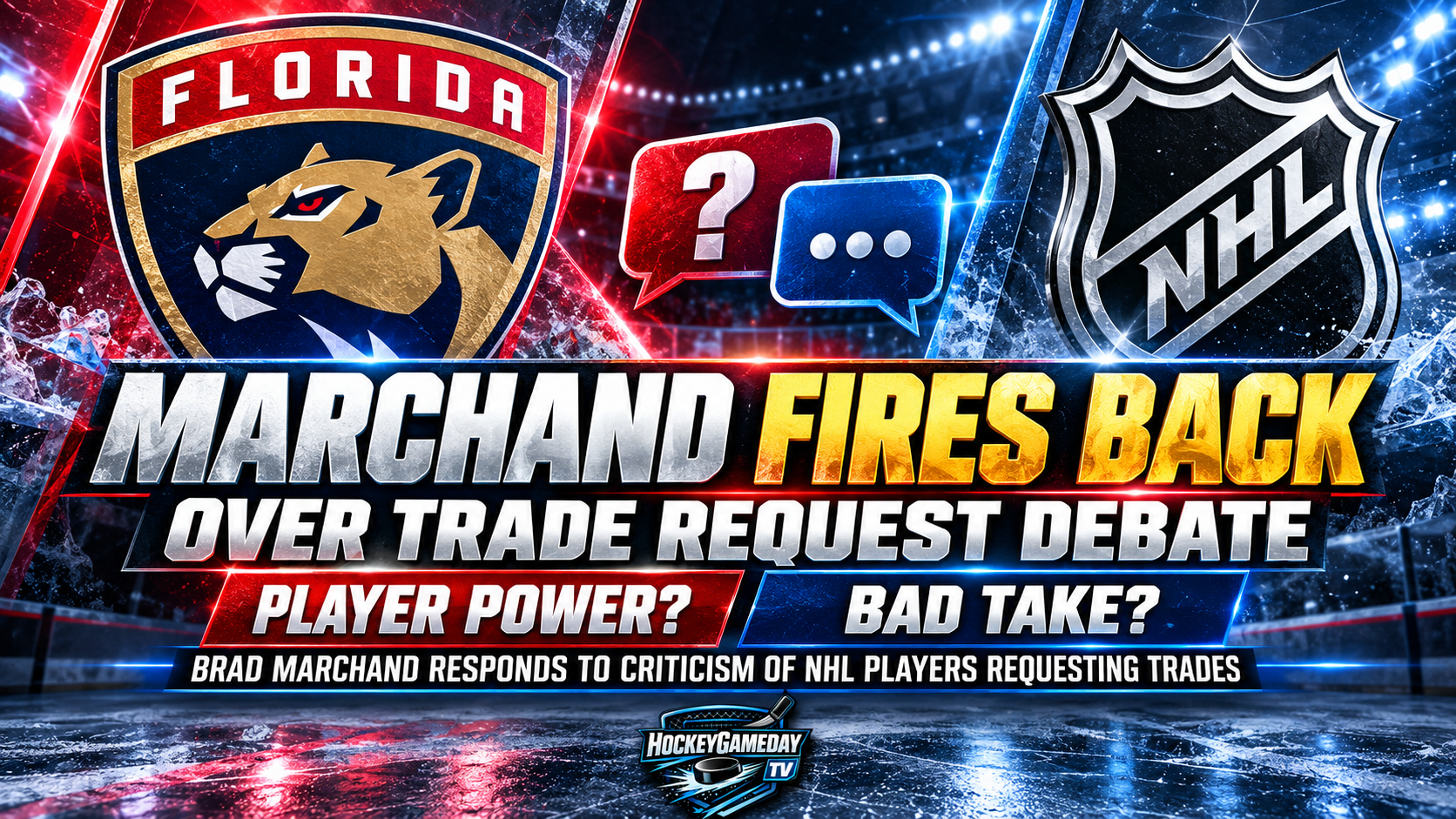
Brad Marchand is back in the Instagram comments, and this time the Florida Panthers forward is challenging a familiar argument about NHL players who request trades while holding contractual protection. His response to a BarDown post adds another chapter to a larger disagreement involving commissioner Gary Bettman and the NHL Players’ Association.
The controversy began with a BarDown graphic featuring Jesse’s criticism of players with no-movement clauses who ask to leave their teams. Jesse argued that the league should send a message to players, insisting that this approach is not how the league should work. Marchand disagreed — and his comments quickly moved the discussion from social-media banter to questions about contracts, team management and player rights.
What Brad Marchand said to BarDown
Responding from his verified Instagram account, @bmarch63, Marchand opened with a direct assessment:
“Such a bad take.”
He then questioned the double standard he sees between players asking to move and NHL clubs signing someone to a long-term deal only to seek a trade later. His first reply concluded with a pointed jab:
“Stick to PlayStation big fella”
In a second comment, Marchand argued that players do not necessarily want out because of a particular city. He pointed instead to situations in which teams are poorly managed or unwilling to spend enough to compete. The comments were captured in screenshots circulating on October 16; they represent Marchand’s opinion, not proof that any specific NHL organization is mishandling its roster.
The real question: Is requesting a trade a breach of a player’s commitment, or simply an attempt to use the leverage negotiated into a contract? The answer depends on what the contract actually allows.
Marchand had already challenged Gary Bettman on this issue
This is not Marchand’s first public response to the trade-clause controversy. On October 2, he weighed in after Bettman questioned whether no-trade protections were being used as originally intended. Marchand argued that the rules cut both ways and called the situation a “broken system.” His comments were reported at the time. We also covered that earlier exchange in our HockeyGamedayTV report on Marchand and Bettman.
The issue carries particular resonance for Marchand, whose long run with Boston ended when the Bruins traded him to Florida at the 2025 deadline. His experiences do not settle the debate, but they help explain why a veteran player might be sensitive to the difference between a team’s rights and a player’s rights.
Marchand’s social-media history: another familiar flashpoint
Marchand has a long history of using social media to joke with — and sometimes needle — other people around hockey. After Florida’s 2025 Stanley Cup victory, for example, he posted tongue-in-cheek thanks to other clubs for letting players go who eventually helped the Panthers build their championship roster. The Hockey News documented the posts.
In September 2026, he also made a sarcastic Instagram comment about Tim Stützle appearing among potential Ottawa Senators captaincy candidates. Stützle played down the remark, while teammate Drake Batherson joked about contacting Marchand over it. Those reactions were reported following Ottawa’s team golf event.
That history makes his latest sarcastic reply unsurprising. This time, however, the underlying issue matters far beyond the comment section.
Gary Bettman’s concern: do trade clauses now do too much?
During an October 1 appearance on Sportsnet’s The FAN Hockey Show, Bettman questioned the growing practice of players asking to leave while using no-trade or no-movement protection to limit destinations. Sportsnet reported his comments as part of the ongoing debate about the purpose of those protections.
“I don’t think that’s a good thing.”
Bettman’s position is that these clauses were intended primarily to provide stability for players who committed to a team, not to give a player an open-ended ability to demand a departure on preferred terms. He also acknowledged that one offseason alone may not justify changing the system, while leaving open the possibility of future conversations with the union.
The NHLPA’s response: protection is part of the bargain
NHLPA executive director Marty Walsh defended the right to negotiate trade protection in an October 14 interview with Sportsnet. His central point: clubs agree to these terms when signing contracts, and those promises do not disappear when team circumstances change.
“It’s the player’s right when they negotiate a contract.”
NHLPA assistant executive director Ron Hainsey went further in responding to Bettman earlier in October. Hainsey characterized the discussion as a challenge to collectively bargained player rights and said the clauses were operating as intended. Read his remarks reported by Sportsnet.
That divide is important: Bettman is questioning how the protections are being used in practice, while union officials are defending the contractual protections themselves. Those are related arguments, but not identical ones.
No-trade clause vs. no-movement clause: the difference
These terms are frequently mixed up, but Sportsnet’s NHL contract glossary explains the distinction:
No-trade clause (NTC): A full NTC generally prevents a team from trading a player without consent. A modified NTC might permit trades except to a negotiated list of clubs, or require an approved-destination list.
No-movement clause (NMC): An NMC extends protection beyond trades to other transactions such as waivers and assignment to the minors, subject to the applicable agreement.
Neither clause forces a team to complete a trade. A player can request a move, and an applicable clause can block certain destinations, but a general manager is not automatically required to make a deal.
The Dylan Larkin example shows both sides of the equation
Detroit’s Dylan Larkin offers a useful real-world example. Former Red Wings GM Steve Yzerman confirmed in June that Larkin had requested a trade and given Detroit a short list of acceptable destinations. But Yzerman did not guarantee the request would be fulfilled, as NHL.com reported.
That is the key balance: a player may have control over where he can be sent, but the organization retains control over whether to accept an offer. The clause is a veto, not an order that a trade must happen.
Our take: player power and team accountability can coexist
Marchand makes a fair point about expectations being different for players and management. When a team changes course, fans often accept it as a necessary business decision. When a player wants a change, that same choice may be judged as a lack of loyalty. Teams and players both have legitimate interests, and neither should be immune from scrutiny.
But Jesse’s concern is not baseless, either. A public trade request can make roster planning harder, narrow a team’s options and frustrate supporters who bought into a long-term commitment. Negotiated protections should be respected, but they do not eliminate the consequences of a contentious departure.
The most useful way to discuss this is to separate three situations: asking for a trade, exercising a contractual veto, and refusing to fulfill playing obligations. They are not interchangeable. Treating them as the same thing obscures what players and clubs are actually allowed to do.
Where the NHL debate goes from here
Marchand’s Instagram replies gave the story a sharp headline, but the larger dispute is about how much say veteran players should have over their careers. Bettman has questioned the direction of the system; Walsh and Hainsey have defended the rights players negotiated. Unless those protections change through the appropriate bargaining process, teams and players remain bound by their existing agreements.
What do you think? Does Marchand have the stronger argument, or should NHL players who sign long-term contracts face more criticism for asking to leave? Join the discussion in the comments.



Leave a Reply