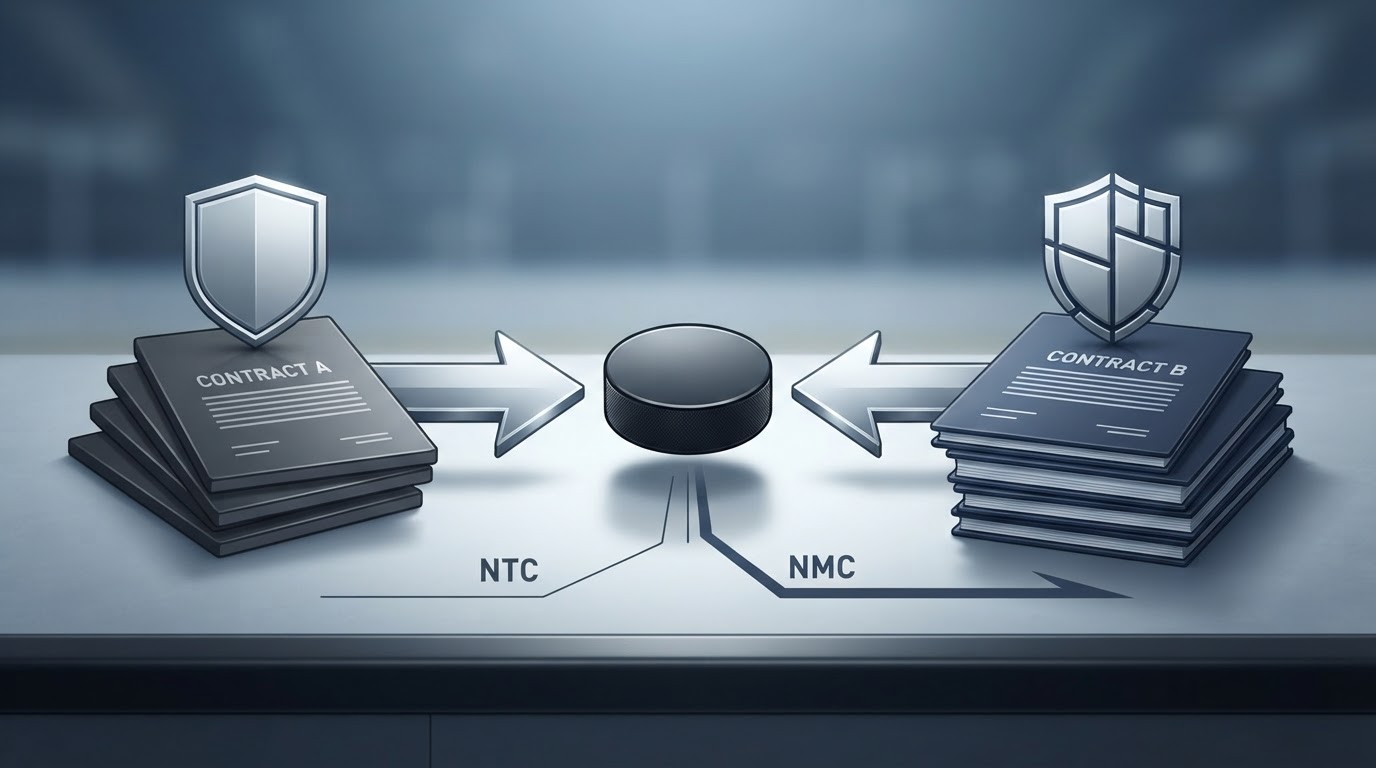
Updated for the 2026-27 NHL season. No-trade clauses and no-move clauses sound similar, but they give NHL players different levels of control. The easiest way to remember the difference is simple: a no-trade clause protects against a trade; a no-move clause protects against more than just a trade.
What is a no-trade clause?
A No-Trade Clause (NTC) means a player cannot be traded in a way prohibited by the clause without his approval.
A full NTC can block any trade unless the player waives it. A modified no-trade clause can instead require the player to submit a list of teams he will accept a trade to, or a list of teams he cannot be traded to.
An NTC does not provide the same protection from waivers or assignment to the minors that a no-move clause does.
What is a no-move clause?
A No-Move Clause (NMC) is broader. Without the player’s approval, the club generally cannot trade him, place him on waivers or assign him to the minors.
That additional waiver and assignment protection is the biggest practical difference between an NMC and an NTC.
No-trade vs no-move: the quick version
| Action | No-Trade Clause | No-Move Clause |
|---|---|---|
| Trade without required approval | No | No |
| Place player on waivers | Generally yes | No without approval |
| Assign player to minors | Possible if other rules allow | No without approval |
| Can be modified to a team list | Yes | Yes |
Who can receive an NTC or NMC?
Movement clauses are tied to unrestricted-free-agent eligibility. Players who are 27 or older or have seven accrued NHL seasons can be eligible for these clauses. A contract can also be structured so the protection begins later, once the player reaches the required eligibility point.
What is a modified no-trade clause?
A modified NTC gives the player some control without providing a complete veto. Common versions include a 10-team no-trade list, a 15-team trade list or another negotiated number of clubs.
For example, if a player has a 10-team no-trade list, he identifies 10 teams the club cannot trade him to without permission. The team can generally trade him to the other eligible clubs.
Can a player waive the clause?
Yes. These protections belong to the player, so the player can agree to waive them for a specific transaction. That is why trade reports often mention a team asking a player to waive his clause before completing a deal.
Why do players negotiate these clauses?
- Family stability.
- Control over where they live and play.
- Avoiding an unwanted rebuild or relocation.
- Protection from being sent to the minors.
- Leverage over a future trade.
Why teams agree to them
Movement protection can be part of the price of signing or extending a veteran player. A player may accept a different salary or term in exchange for more control, while the club secures the player it wants.
Why it matters during trade season
A player with significant trade protection can dramatically shrink a team’s market. Even if 20 teams are interested, the player may only approve a handful. That can change both the timing of a trade and the return the selling team receives.
More HockeyGamedayTV explainers
Next, read our guides to RFA vs UFA, retained salary, and NHL waivers.
Rule references: NHL/NHLPA Collective Bargaining Agreement and current PuckPedia contract-clause guidance.
HockeyGamedayTV NHL Explainer Series: Waivers • LTIR • Salary Cap • Retained Salary • No-Trade vs No-Move Clauses • RFA vs UFA
More NHL rules explained: Visit the HockeyGamedayTV NHL Explainer Library for guides to contracts, free agency, waivers, LTIR, trades and the salary cap.
Practical fan scenario — November 2026
Trade protection does not mean every form of movement is identical
Suppose a veteran has a modified no-trade clause listing teams to which he can or cannot be traded. That is different from a full no-move clause, and neither should be reduced to the simple statement “he controls everything.” The exact clause, its start date, and whether the player waives protection are crucial.
When evaluating a trade rumour, first find the player’s contract and the precise wording of his protection. Next separate a trade from assignment or waivers, since protection can apply differently. Finally, remember that reported willingness to consider a destination does not prove a deal is complete. Use the NHL’s official CBA documentation for general rights, and a reliable contract record for any named player’s situation. For another way to separate reporting and imagination, consult our trade-verification guide.