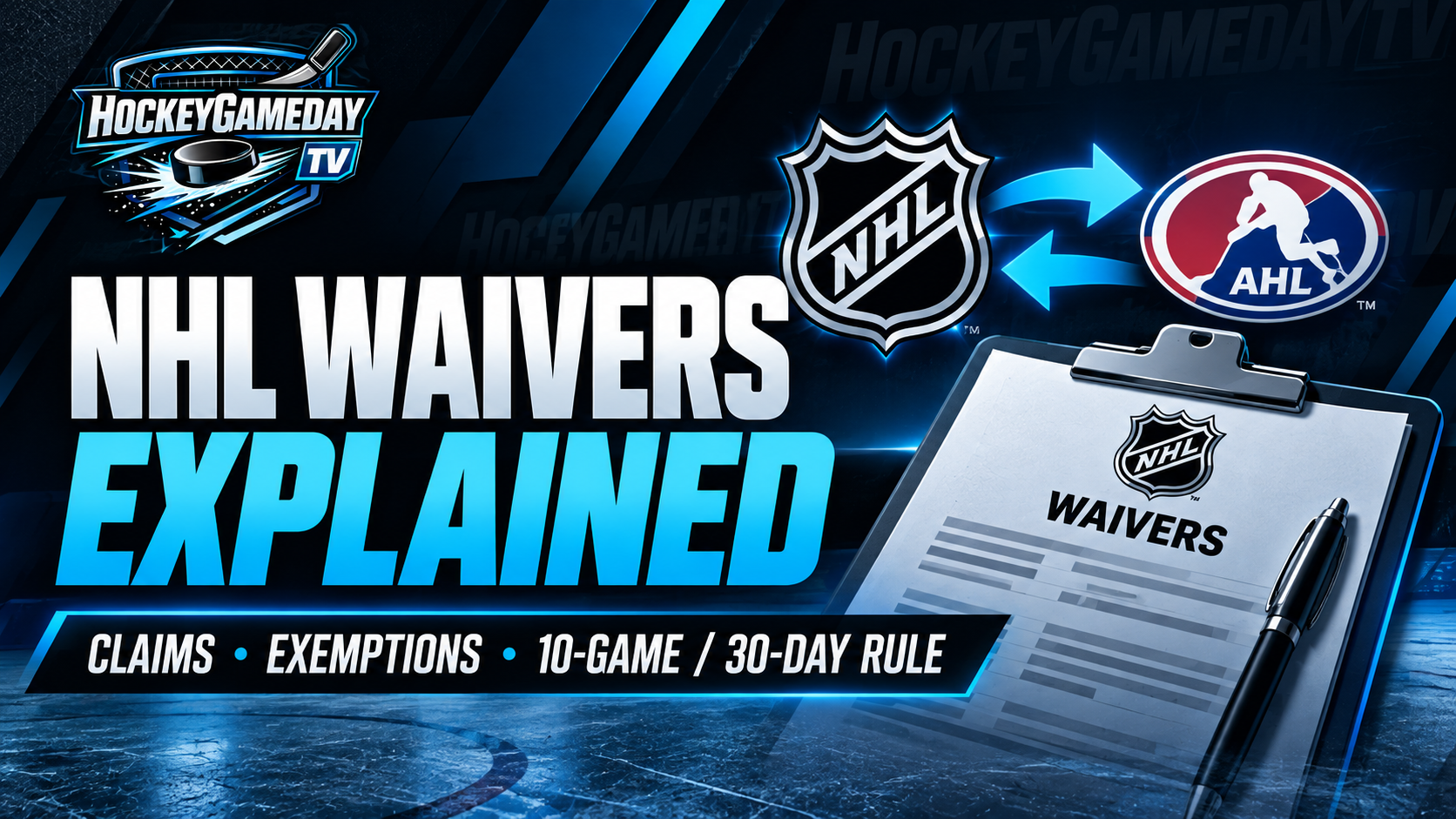
Updated for the 2026-27 NHL season. NHL waivers are one of the most important — and most misunderstood — parts of roster management. Every fall, fans see established players placed on waivers and younger players sent to the AHL without appearing on the waiver wire at all. The difference comes down to exemption status, NHL experience and whether a player has already cleared.
What are NHL waivers?
Waivers are the process NHL teams generally must use before assigning a waiver-eligible player to the minor leagues. Once a player is placed on waivers, the other NHL clubs have an opportunity to submit a claim.
If nobody claims the player, he clears waivers and can be assigned to the minors. If another club claims him, that club takes over the player under his existing contract.
Why can some players be sent down without waivers?
Young players are normally waiver-exempt for a period of time after signing their first NHL contract. The length of that exemption depends primarily on the player’s waiver age, position and NHL games played.
For skaters, the exemption can range from one season for a player who signs at age 25 or older to as many as five seasons for an 18-year-old. The NHL-games threshold also varies: younger skaters can remain exempt up to 160 NHL games, while players who sign later reach waiver eligibility sooner.
Goaltenders generally receive longer exemption windows than skaters. An 18-year-old goalie can be exempt for as many as six seasons or 80 NHL games, while an older goalie can become waiver-eligible much sooner.
The 10-game / 30-day rule
One of the most useful rules for fans to remember is this: after a waiver-eligible player clears waivers, he can usually move between the NHL and AHL without clearing again until he has either played 10 cumulative NHL games or spent 30 cumulative days on an NHL roster.
Once one of those limits is reached, the player generally needs waivers again before he can be assigned to the minors.
What happens when a player is claimed?
A waiver claim is not a trade. The claiming team does not send an asset back. It simply takes the player’s contract and adds him to its organization.
If the claiming club later wants to send that player to the minors, the player normally has to go through waivers again. There is a special exception if the team that most recently lost the player is the only club to claim him back; in that circumstance, that team can generally assign him directly to the minors, provided the applicable timing and games-played limits have not been exceeded.
How is waiver priority determined?
When more than one club submits a claim, priority is determined under the league’s waiver-order rules. Early in a season, the prior season’s standings can be relevant; later, the current standings become the basis. The practical result is that teams lower in the applicable standings order receive priority over stronger clubs.
Why teams sometimes waive useful players
- They need to become roster- or salary-cap compliant.
- A younger waiver-exempt player may be easier to send down, but management may prefer keeping that player in the NHL.
- A veteran may be squeezed out because of position depth.
- The club may believe the player’s contract makes a claim unlikely.
- The team may want the flexibility to move the player between the NHL and AHL after he clears.
A waiver placement does not necessarily mean a team is giving up on a player
This is one of the biggest misconceptions. Sometimes a player is waived because the club wants to preserve roster flexibility, not because it wants to lose him. Teams routinely calculate the risk of a claim against the value of getting a player through waivers and creating future movement options.
The easiest way to follow waivers
When you see a player placed on waivers, ask three questions: Is he waiver-eligible? Has he cleared recently? And would another club realistically want the contract and roster spot? Those three questions explain most waiver decisions.
For current eligibility tracking and detailed exemption tables, PuckPedia’s waivers explainer is an excellent reference. The underlying system comes from the NHL/NHLPA Collective Bargaining Agreement.
More NHL contract and roster explainers
HockeyGamedayTV also breaks down the other rules that shape roster building. Read our explainer on how NHL offer sheets work, and watch for more salary-cap and CBA guides throughout the 2026-27 season.
HockeyGamedayTV NHL Explainer Series: Waivers • LTIR • Salary Cap • Retained Salary • No-Trade vs No-Move Clauses • RFA vs UFA
More NHL rules explained: Visit the HockeyGamedayTV NHL Explainer Library for guides to contracts, free agency, waivers, LTIR, trades and the salary cap.