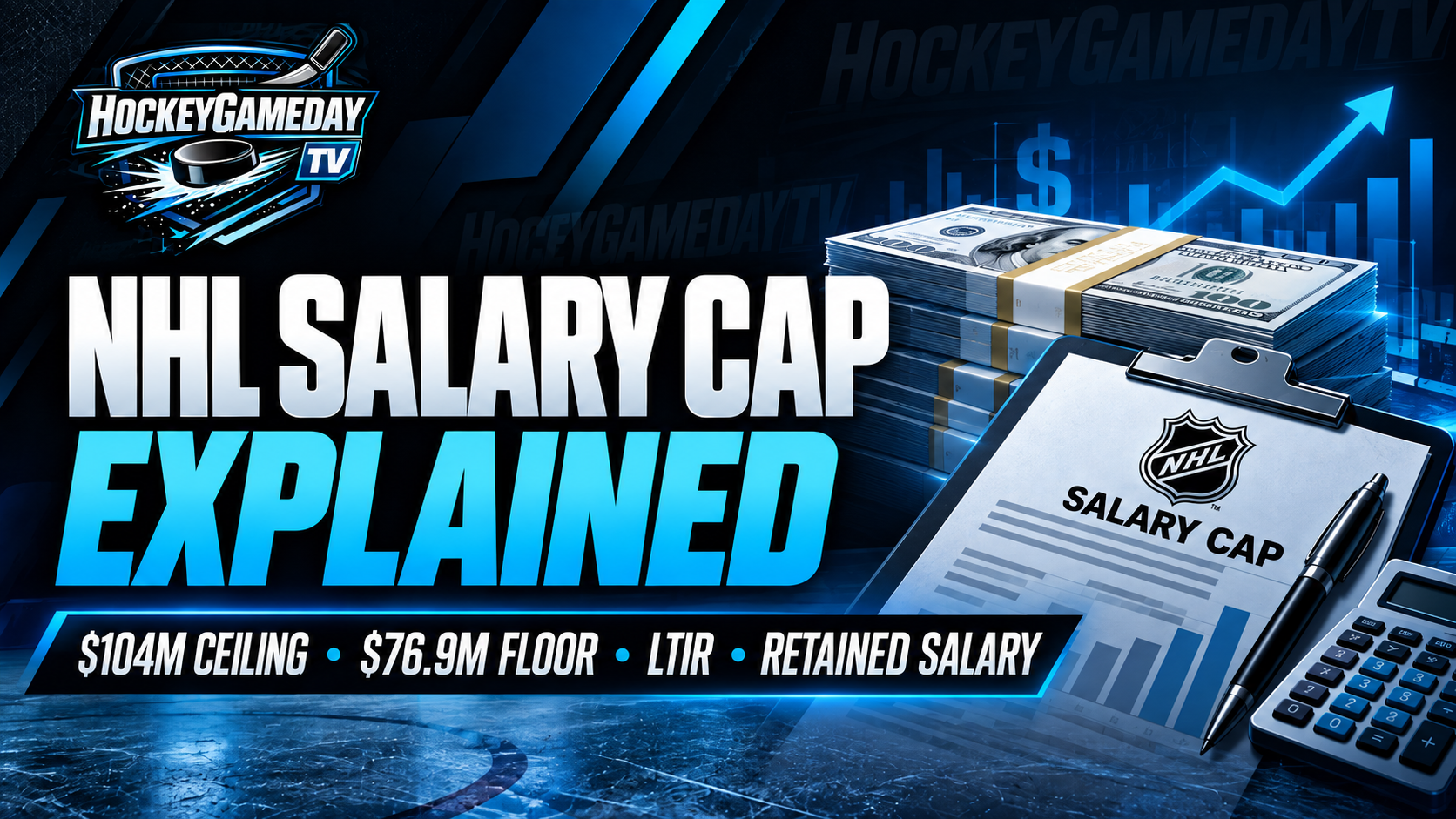
Updated for the 2026-27 NHL season. The NHL salary cap shapes almost every trade, free-agent signing and roster move. For 2026-27, the league’s upper limit is $104 million and the lower limit is $76.9 million.
What is the NHL salary cap?
The NHL uses a hard salary-cap system negotiated between the league and the NHL Players’ Association. Each team must build its roster within an annual payroll range, subject to specific exceptions and accounting rules in the Collective Bargaining Agreement.
For 2026-27, the official payroll range is:
- Upper limit: $104.0 million
- Midpoint: $90.4 million
- Lower limit: $76.9 million
Cap hit is not always the same as salary
A player’s salary in a particular season and his salary-cap hit can be different. For standard contracts, the cap hit is generally based on the average annual value of the contract rather than simply the cash salary paid in that year.
That is why a player can receive more money in one season than another while carrying the same cap hit each year.
What is cap space?
Cap space is the amount of room a team has below the ceiling, but the useful number can change throughout the season because NHL cap accounting is calculated over the league year. Teams that remain below the ceiling can effectively accumulate additional flexibility as the season progresses.
This is why a team that appears to have only modest projected room in October can sometimes add a significantly larger annual cap hit near the trade deadline.
What happens when a player goes on LTIR?
Long-Term Injured Reserve does not erase a player’s cap hit. Instead, a qualifying injury can allow the team to exceed the normal ceiling by an amount determined under the LTIR rules.
For 2026-27, the rules also distinguish between returning players and players designated as out through the playoffs. That makes LTIR planning more restrictive than it was in earlier cap eras.
The new playoff salary cap
One of the biggest changes in the new CBA is the introduction of a salary-cap restriction during the Stanley Cup Playoffs. The league now applies a cap calculation to the players dressed for a playoff game, rather than allowing teams to activate expensive players with no meaningful postseason cap constraint.
This change was designed in part to address years of criticism surrounding teams that used LTIR during the regular season and then entered the playoffs with a lineup whose combined cap value would not have fit under the regular-season ceiling.
What is the salary floor?
The NHL also has a minimum payroll requirement. In 2026-27, that lower limit is $76.9 million. Teams cannot simply strip their roster down indefinitely to save money; they must meet the league’s payroll-floor requirements.
Why retained salary matters in trades
In some trades, the team moving a player can retain a portion of his salary and cap hit. That can make an expensive contract easier for another team to acquire, but retained-salary transactions come with CBA limits and continue to count against the retaining club’s cap.
Why waiver moves can be cap moves
Waivers are often discussed as a talent decision, but many waiver placements are driven by the salary cap and roster limit. Assigning a player to the AHL can create some cap relief, depending on the player’s contract and the league’s buried-cap rules.
The cap explains more NHL transactions than almost anything else
When a trade looks confusing, start with the cap. Ask how much room each team has, whether salary is being retained, whether an injured player is on LTIR, and whether a player can be sent to the minors without waivers. Those details often explain why the transaction was structured the way it was.
The NHL and NHLPA officially set the 2026-27 upper limit at $104 million and the lower limit at $76.9 million. For live team-by-team cap tracking, PuckPedia provides current payroll and roster calculations.
Keep learning
Next, read HockeyGamedayTV’s guide to NHL offer sheets. We are building a full library explaining the rules behind NHL trades, contracts, waivers, free agency and roster construction.
HockeyGamedayTV NHL Explainer Series: Waivers • LTIR • Salary Cap • Retained Salary • No-Trade vs No-Move Clauses • RFA vs UFA
More NHL rules explained: Visit the HockeyGamedayTV NHL Explainer Library for guides to contracts, free agency, waivers, LTIR, trades and the salary cap.